Have you ever felt as though you were doing everything you were supposed to do?
You set goals. You visualize. You repeat affirmations. You work hard. You try to stay positive.
And yet, the thing you want still feels frustratingly far away.
The more you want it, the more you think about it. The more you think about it, the more you wonder why it hasn’t happened. Eventually, you may find yourself constantly checking for results, questioning your progress, and trying to figure out exactly what you need to do next.
Sound familiar?
According to manifestation teachings, this is often where resistance enters the picture.
You want something—but at the same time, you fear you may not receive it. You desire a better future, but your attention keeps returning to what is missing in the present. You take action, but beneath that action there may be anxiety, doubt, or a desperate need to control the outcome.
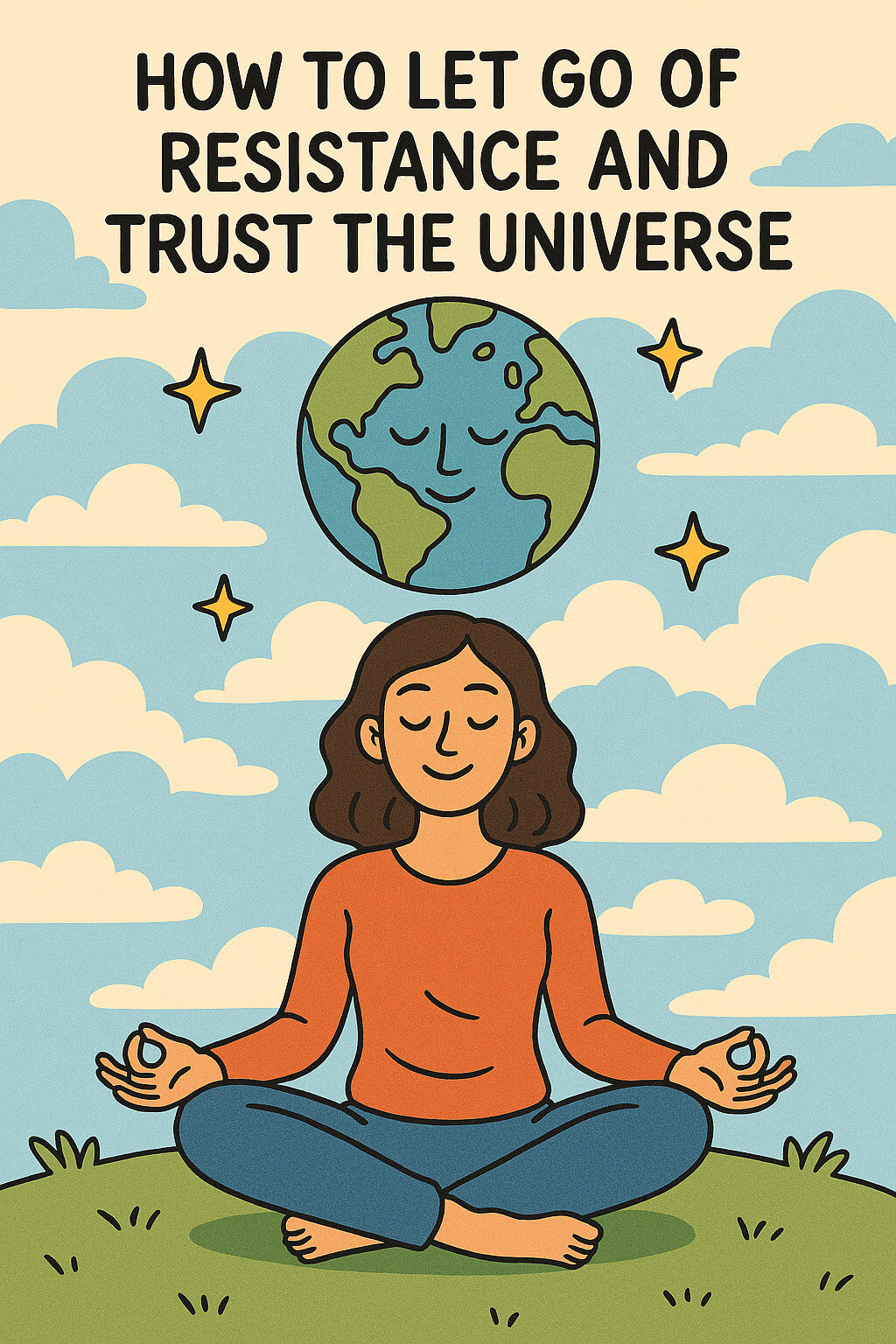
Learning how to let go of resistance and trust the universe is not about becoming passive or pretending that problems do not exist. It is about learning the difference between taking responsibility for your life and trying to control everything.
Sometimes, the harder you push, the more exhausted you become.
And sometimes, the most powerful thing you can do is take the next step, release what you cannot control, and allow life to unfold.
What Is Resistance?
Resistance can be understood as the inner tension between what you consciously want and what you fear, doubt, or believe is impossible.
You may say:
“I want more money.”
But another part of you may be thinking:
“People like me never become wealthy.”
You may say:
“I want to find love.”
While quietly wondering:
“What if I get hurt again?”
You may want success, freedom, confidence, or a completely different life. But if your mind repeatedly focuses on why you cannot have those things, you create an internal conflict.
In manifestation and personal-development teachings, this conflict is often called resistance.
Think of it like driving with one foot on the accelerator and the other on the brake. You are expending energy, but you are also working against yourself.
Resistance can appear in many forms:
- Constantly worrying about whether your manifestation is working.
- Checking repeatedly for evidence or results.
- Feeling frustrated about how long something is taking.
- Overthinking every decision.
- Comparing your progress with other people.
- Trying to control every possible outcome.
- Feeling that you cannot be happy until you get what you want.
The important thing to understand is this:
Resistance does not mean you are broken.
It simply gives you something to become aware of.
The moment you notice that you are caught in fear, impatience, or overthinking, you have an opportunity to pause and choose a different response.
The goal is not to become a person who never experiences doubt.
The goal is to stop allowing doubt to control your next move.

The Power of Allowing
Many people approach manifestation as if they need to force reality to obey them.
They visualize harder.
They repeat more affirmations.
They search for the perfect technique.
They constantly ask, “What else do I need to do?”
But there is another approach: allowing.
Allowing means becoming clear about what you want while releasing the need to control every detail of how it arrives.
It means:
- Releasing the need to control every detail.
- Trusting the process even when you cannot yet see the full path.
- Letting go of attachment to a specific timeline.
- Remaining open to opportunities you did not originally expect.
- Taking meaningful action without obsessing over the outcome.
Imagine planting a seed.
You prepare the soil. You plant it. You water it. You give it the conditions it needs.
But you do not dig it up every morning to see whether it has grown.
You do your part—and then you allow the process to continue.
This is a useful way to think about your goals and desires.
Set the intention.
Take the appropriate action.
Then stop treating every moment without visible results as proof that nothing is happening.
When you release the constant need for reassurance, you create more mental and emotional space to notice possibilities that may already be available to you.
Many people also find that when they stop obsessing over one specific outcome, they become more flexible, creative, and willing to recognize unexpected opportunities.
That is the power of allowing.

How to Let Go of Resistance
Letting go is not a single decision you make once.
It is a practice.
Some days you will feel confident and trusting. Other days, fear or impatience may return.
That is normal.
The key is to notice when you have moved from intentional action into desperate control.
Here are several ways to begin releasing resistance.
1. Recognize When You Are Resisting
Awareness is the beginning of change.
Resistance often becomes powerful because it operates automatically. You may spend hours worrying about something without realizing that your attention has become completely consumed by it.
Start paying attention to the signs.
Ask yourself:
- Am I taking useful action, or am I trying to force an outcome?
- Am I thinking about possibilities, or only about what could go wrong?
- Am I repeating the same fearful thoughts?
- Am I constantly looking for proof that my desire is coming?
- Am I making decisions from confidence or panic?
You do not need to criticize yourself for the answers.
Simply notice.
For example, if you want to build wealth, there is a difference between reviewing your finances and taking practical steps to improve them versus checking your account repeatedly while feeling hopeless about every number.
One approach creates clarity.
The other creates more stress.
The ability to recognize that difference gives you the power to shift.
2. Breathe, Pause, and Stop Pushing for a Moment
When resistance takes over, your first instinct may be to do more.
Send another message.
Search for another answer.
Change your plan again.
Try another technique.
Sometimes, however, the better first step is to pause.
Take a slow breath.
Relax your shoulders.
Step away from the mental argument.
You do not have to solve your entire future in the next five minutes.
A brief pause can help you create distance between what is happening and your immediate emotional reaction to it.
You can then ask:
What is actually within my control right now?
Maybe there is one useful action you can take.
Maybe there is nothing else you need to do today.
Both answers are valuable.
Learning to pause before reacting can prevent fear from becoming your decision-maker.
3. Let Go of the Need to Know Exactly How and When
One of the biggest sources of resistance is the obsession with how and when.
You may know exactly what you want but have no idea how you will get there.
That uncertainty can feel uncomfortable.
But not knowing the entire path does not mean there is no path.
If your goal is to start a successful business, improve your finances, find a meaningful relationship, or create a new life, you do not need to have every answer before taking the first step.
You only need enough clarity to take the next appropriate step.
According to manifestation teachings, your role is to become clear about your intention and remain open to the paths through which it may unfold.
Your practical role is to learn, prepare, make decisions, and act when opportunities appear.
You do not need to predict the entire future.
In fact, trying to do so can become another form of resistance.
Trusting the universe—or trusting God, life, or a higher intelligence, depending on your beliefs—means accepting that you may not always see the complete picture.
You can still move forward.
4. Change Your Relationship With Delays and Setbacks
It is easy to trust when everything is going your way.
The real challenge comes when something does not work out.
You apply for an opportunity and receive a rejection.
A plan falls apart.
A relationship ends.
A goal takes longer than expected.
This is often when resistance becomes strongest because the mind wants an explanation immediately.
Why did this happen?
Why is this taking so long?
What did I do wrong?
Instead of automatically assuming that every setback means failure, consider asking better questions:
- What can I learn from this?
- Is there something practical I need to change?
- Could this situation be redirecting me?
- What opportunity might I be missing because I am focused only on what did not work?
This does not mean pretending that every difficult experience is enjoyable or claiming that everything happens exactly as you want it to.
It means choosing not to give every setback the power to destroy your sense of direction.
From a spiritual perspective, many people choose to see delays and detours as part of a larger journey.
From a practical perspective, setbacks can also provide feedback, experience, and opportunities to adjust.
Either way, resistance begins to lose its power when you stop interpreting every obstacle as a final answer.
5. Feel the Outcome Before You See the Evidence
One of the most important ideas in manifestation is learning not to postpone your emotional state until after you receive what you want.
Many people unconsciously say:
“When I have more money, then I’ll feel secure.”
“When I find the right relationship, then I’ll feel loved.”
“When I become successful, then I’ll feel confident.”
But this can create a cycle where your sense of peace is always placed somewhere in the future.
A manifestation-based approach encourages you to begin cultivating the emotional qualities you associate with your desired life now.
If you desire wealth, you might begin practicing gratitude, responsibility, confidence, and a greater awareness of opportunity.
If you desire love, you might focus on becoming more open, compassionate, and connected.
If you desire success, you might begin developing the habits and self-belief associated with the person you want to become.
This is not about pretending that you already possess something you do not have.
It is about refusing to wait for external circumstances before developing the inner qualities you want to experience.
You can begin becoming that person now.
6. Take Action—but Release Your Attachment to the Outcome
This is where many people misunderstand the idea of surrender.
Letting go does not mean doing nothing.
You cannot simply decide that you want a new life and expect every practical responsibility to disappear.
You still have to participate.
You still have to make decisions.
You still have to take action.
The difference is where your action comes from.
Forced action often comes from fear.
It sounds like:
“If I don’t make this happen immediately, everything will fall apart.”
Inspired action comes from a different place.
It asks:
“What is the next meaningful step I can take?”
For example, if you want to improve your financial situation, inspired action might mean learning a valuable skill, applying for opportunities, starting a project, improving your financial habits, or creating a plan.
If you want to improve a relationship, it might mean having an honest conversation, improving your communication, or becoming clearer about your own boundaries.
If you want to create a new future, it may mean taking a step that feels uncomfortable—but necessary.
Trusting the universe does not remove your responsibility.
It can help you release the belief that you must personally control every variable.
You take the step.
You do your best.
You learn from the response.
Then you take the next step.
That is a far more sustainable approach than trying to force the entire journey into existence at once.
The Serenity Prayer: A Powerful Lesson in Surrender and Action
One of the most powerful reminders of the balance between acceptance and action is the Serenity Prayer:
“God, grant me the serenity to accept the things I cannot change, the courage to change the things I can, and the wisdom to know the difference.”
This simple prayer contains a powerful framework for life.
There are things you can influence.
Your choices.
Your effort.
Your habits.
Your attitude.
Your willingness to learn.
Your response to difficult situations.
And there are things you cannot fully control.
Other people.
The past.
Timing.
Unexpected events.
The exact outcome of every action you take.
A great deal of resistance comes from trying to control the second category while neglecting the first.
The Serenity Prayer offers a different approach.
Accept what you cannot change.
Take courage where you can make a difference.
Develop the wisdom to know which is which.
This is not passive surrender.
It is intelligent surrender.
You stop wasting energy fighting reality and direct that energy toward meaningful action.
For many people, this balance between trusting God or the universe and taking personal responsibility becomes one of the most freeing shifts they can make.
You do what you can.
Then you let go of the rest.
8. Stop Checking Whether It Is Working
Imagine planting a seed and digging it up every day.
You would interrupt the very process you are trying to observe.
Yet many people do something similar with their goals.
They visualize for a few days and then ask:
“Where is it?”
They take one action and immediately demand proof.
They begin a new habit and expect their entire life to change overnight.
This constant checking can become another form of resistance because your attention remains fixed on the absence of what you want.
Try a different approach.
Set aside time to review your progress practically.
Evaluate your goals.
Look at your results.
Make adjustments when necessary.
But do not spend every waking moment demanding reassurance.
There is a difference between evaluating and obsessing.
Evaluation helps you improve.
Obsession keeps you emotionally attached to what you cannot currently control.
Trust allows you to take your hands off the steering wheel occasionally without abandoning the journey.
Living in Flow With the Universe
When you begin releasing resistance, you may find that life feels different.
Not because every problem suddenly disappears.
Not because you never experience uncertainty again.
But because you stop meeting every challenge with the same level of fear.
You become more present.
You become more observant.
You become more willing to adapt.
In spiritual and manifestation traditions, this state is often described as flow or alignment.
You stop chasing every outcome from a place of desperation.
Instead, you become clear about what you want, take action, and remain open.
You may notice a new idea at the right time.
You may meet someone who introduces you to an opportunity.
You may realize that the plan you were desperately trying to force was not actually the best path for you.
Many practitioners interpret these experiences as synchronicity or guidance. From a practical perspective, becoming less consumed by anxiety can also make it easier to notice information, relationships, and possibilities that you may have previously overlooked.
Either way, the experience of flow begins with a simple shift:
You stop trying to control everything
A Simple Daily Practice for Releasing Resistance
If you want to make this part of your daily life, try this simple practice whenever you feel yourself becoming overwhelmed.
Step 1: Name What You Want
Be clear about your intention.
What are you trying to create, improve, or experience?
Step 2: Identify What You Can Control
Ask yourself:
What is one useful action I can take?
Do it.
Step 3: Release What You Cannot Control
Remind yourself that you cannot control every person, event, or outcome.
Let go of the need to solve everything immediately.
Step 4: Return to the Serenity Prayer
Say:
“God, grant me the serenity to accept the things I cannot change, the courage to change the things I can, and the wisdom to know the difference.”
Allow those words to bring you back to the present moment.
Step 5: Trust and Continue Living
Do not put your life on hold while waiting for your desire.
Enjoy your day.
Learn.
Create.
Connect with people.
Take care of your responsibilities.
Stay open.
The more your life becomes centered around meaningful living rather than constant waiting, the easier it becomes to release attachment.
Final Thoughts: Relax, Trust, and Watch the Magic Unfold
You do not have to force every door to open.
You do not need to know every step before you begin.
And you do not have to spend every day worrying about whether life is giving you exactly what you asked for.
Learning how to let go of resistance and trust the universe is ultimately about finding a better balance between intention and surrender.
Know what you want.
Take responsibility for what you can do.
Develop the courage to act.
Release the need to control what is beyond you.
Trust God, the universe, life, or the path ahead in whatever way feels meaningful to you.
Then keep moving forward.
Because letting go is not giving up.
Sometimes, letting go is what allows you to finally move.