What if one of the simplest ways to change the direction of your life started with a blank page?
No complicated ritual. No special talent. No need to wait until you feel completely confident.
You simply begin writing.
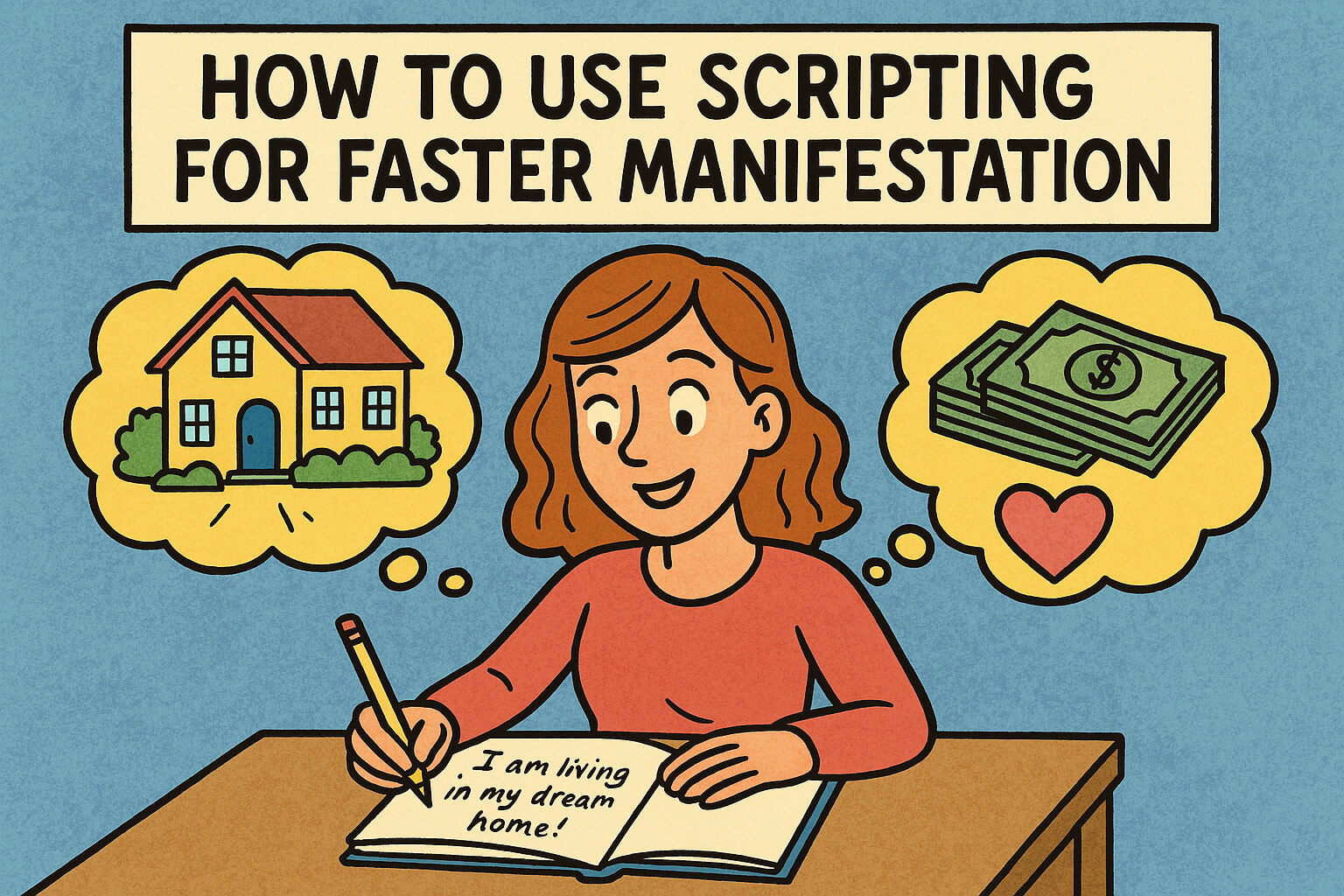
According to manifestation teachings, scripting is the practice of writing about your desired reality as though it has already happened. Instead of constantly focusing on what you lack, you deliberately direct your attention toward the life you want to experience.
For many people, that shift can be powerful.
Your thoughts influence your decisions. Your expectations influence what you notice. And the stories you repeatedly tell yourself can shape how you approach opportunities, challenges, money, relationships, and personal growth.
That is why scripting is more than simply writing down a wish.
It is a way of repeatedly focusing your attention on a new possibility.
In manifestation practice, many people believe that when your thoughts, emotions, beliefs, and actions begin moving in the same direction, you become more aligned with the reality you want to create.
So, if you want to learn how to use scripting for manifestation, this guide will show you how to do it, how to make your scripts more meaningful, the mistakes to avoid, and how to combine scripting with other mindset practices for potentially faster results.
What Is Scripting for Manifestation?
Scripting for manifestation is a technique where you write about your desired life as if you are already experiencing it.
You might write about receiving an exciting opportunity, achieving a financial goal, building a successful business, feeling more confident, or living a life that feels more fulfilling.
The key is to move beyond writing:
“I want this.”
Instead, you begin writing from the perspective of:
“I am grateful that this is now part of my life.”
For example:
“I am so grateful that my work is creating new opportunities for me. I feel more confident every day, and I am excited about the income and freedom I am creating.”
Or:
“I can hardly believe how much my life has changed. I wake up feeling focused, motivated, and grateful for the opportunities that continue to appear.”
The purpose is not simply to repeat words mechanically.
The real power of scripting comes from creating a clear mental and emotional connection with the future you want.
In manifestation traditions, this practice is often associated with the idea of living from the end—mentally and emotionally connecting with the experience of having already achieved your desire.
At a practical level, writing can also help you clarify vague goals, organize your thoughts, and repeatedly bring your attention back to what matters.
That combination is what makes scripting such an interesting personal-development tool.

Why Scripting Can Feel So Powerful
Most people spend a surprising amount of time mentally rehearsing what they do not want.
They think about bills they cannot pay.
Problems they cannot solve.
Mistakes they made years ago.
Reasons something probably will not work.
Then they wonder why it is difficult to feel motivated, hopeful, or focused on creating something different.
Scripting gives you an opportunity to interrupt that pattern.
When you regularly write about the life you want, you begin rehearsing a different internal story.
Instead of constantly identifying as the person who is struggling, you start exploring the mindset of the person who is growing, learning, succeeding, and moving forward.
Many manifestation practitioners believe this helps shift your energetic state. From a personal-development perspective, it can also encourage you to think more clearly about what you actually want and how you want to show up.
The important part is consistency.
One enthusiastic page written once may inspire you.
A repeated practice can become part of how you direct your attention every day.
The Right Way to Script for Faster Manifestation
There is no single script that guarantees a specific result. However, certain principles can make your scripting practice more focused and meaningful.
1. Write From the Perspective of Already Having Your Desire
Avoid constantly placing your desire somewhere in the distant future.
Instead of:
“One day, I will be financially successful.”
Try:
“I am grateful for the financial progress I am creating. I am becoming more confident with money, recognizing valuable opportunities, and taking action toward greater freedom.”
You can write in the present tense or as though you are looking back on something that has already happened.
For example:
“I still remember the moment I realized that my persistence had paid off. The opportunities I had been working toward were finally beginning to come together.”
Choose whichever approach helps you connect most naturally with the experience.
2. Get Specific About What You Want
Vague desires often create vague scripts.
Instead of writing:
“I want to be happy and successful.”
Ask yourself:
- What does success actually look like to me?
- What would an ideal day feel like?
- What changes would I notice in my habits?
- What opportunities would I be grateful for?
- How would greater financial freedom affect my daily life?
Then bring those details into your script.
For example:
“I wake up feeling calm and focused. I know exactly what I want to accomplish today. I enjoy working on projects that move me closer to financial freedom, and I feel grateful for the progress I continue to make.”
The clearer the picture, the easier it becomes to emotionally connect with it.
3. Engage Your Emotions
A script does not need to be dramatic.
But it should mean something to you.
As you write, pay attention to the emotions connected to your desired reality.
Would you feel grateful?
Relieved?
Confident?
Excited?
Peaceful?
Try to bring some of those feelings into your writing.
For example:
“I feel an incredible sense of gratitude knowing that I stayed committed to my vision. I trust myself more, I make better decisions, and I feel genuinely excited about what I am creating.”
Many manifestation teachings emphasize emotion because thoughts without emotional involvement can feel empty and disconnected.
You do not have to force yourself to feel euphoric. Even a quiet sense of gratitude, hope, or confidence can make the practice feel more authentic.
4. Make Your Script Feel Believable
One of the biggest mistakes people make is writing something so extreme that every sentence immediately triggers resistance.
If writing, “I am a billionaire,” makes you instantly think, “That will never happen,” your attention may remain focused on the gap between your current reality and your desired one.
Start where you can create a genuine sense of possibility.
For example:
“I am becoming more open to new ways of creating income.”
Or:
“I am learning to recognize opportunities that I may have overlooked before.”
As your confidence grows, your scripting can evolve with you.
Manifestation does not have to begin with pretending that you are already living an entirely different life. Sometimes the most powerful shift begins with changing what you believe is possible.
5. Repeat the Practice Consistently
You do not necessarily need to write ten pages every day.
A focused page written consistently can be more valuable than an exhausting routine you abandon after three days.
You might script:
- Every morning to set the direction of your day.
- Every evening to reinforce your intentions.
- Before meditation or visualization.
- Whenever you feel disconnected from your goals.
Consistency gives your desired vision more space in your daily thinking.
Over time, you may find that your scripts become clearer because you become clearer.
How to Make Your Scripting Practice More Powerful
Once you understand the basics, you can combine scripting with other manifestation and mindset practices.
Start With Gratitude
Before writing about what you want, spend a few moments acknowledging what is already working in your life.
Write down three things you genuinely appreciate.
They do not have to be extraordinary.
You might appreciate:
- A new opportunity.
- A supportive person.
- Progress you have made.
- A lesson you recently learned.
- The fact that you are taking action toward change.
Gratitude can help shift your attention away from constant lack and toward appreciation.
Then move naturally into your desired reality.
Add Visualization After Scripting
After finishing your script, close your eyes for a few minutes.
Imagine yourself living the experience you just described.
What do you see?
What are you doing?
Who are you becoming?
How do you feel?
You do not need to create a perfect mental movie. Simply allow yourself to connect with the possibility.
Visualization can complement scripting because you are reinforcing your intention through both words and imagination.
You can also explore the power of visualization as part of a broader manifestation practice.
Read Parts of Your Script Aloud
Writing engages your attention in one way.
Speaking can make your words feel more immediate.
Choose a few lines from your script and read them slowly.
Do not rush.
Pause.
Let the words sink in.
For example:
“I trust myself to recognize opportunities.”
“I am creating a stronger relationship with wealth.”
“I am becoming more confident in my ability to create positive change.”
The goal is not to perform your script.
The goal is to connect with it.



Common Mistakes That Can Weaken Your Scripting Practice
1. Writing From Desperation
There is a difference between wanting something and feeling that your entire life depends on receiving it immediately.
If every scripting session is filled with panic, constantly return to the idea of creating rather than chasing.
Instead of asking, “Why don’t I have this yet?”
Ask:
“Who am I becoming as I move toward this?”
That question can create a more empowering focus.
2. Being Too Vague
“I want a better life” is difficult to visualize.
A better life could mean almost anything.
Give your subconscious and conscious mind a clearer direction by describing the experiences, habits, goals, and feelings that matter to you.
3. Repeating Words Without Feeling
Copying the same sentence fifty times does not automatically make it meaningful.
Slow down.
Change the wording.
Describe different moments.
Write a conversation, a memory, or a scene from your desired future.
Make the experience personal.
4. Ignoring Practical Action
Scripting can help you clarify your vision, but manifestation practices do not require you to remain passive.
If you are scripting about a successful business, look for ways to improve your skills.
If you are manifesting financial freedom, learn more about money, opportunities, and valuable habits.
If you are scripting about confidence, practice doing things that require courage.
Your inner world and your actions can support each other.
Combining Scripting With The Overnight Script for Faster Results
If you want to create a stronger daily mindset routine, you can combine scripting with The Overnight Script.
Scripting gives you an opportunity to consciously define what you want.
The Overnight Script is designed as an audio-based personal-development program intended to support wealth-oriented mindset and subconscious reprogramming while you sleep.
The combination can create a simple evening ritual:
Step 1: Write Your Script Before Bed
Take a few minutes to describe your desired future.
Focus on the experiences, emotions, opportunities, and personal growth you want to create.
Write as though you are already experiencing positive progress.
Step 2: Read Your Script Slowly
Read a few key passages aloud or silently.
Focus on the feelings behind the words.
Let the final thoughts of your day be connected to the direction you want to move in rather than automatically replaying stress, doubt, or frustration.
Step 3: Listen to The Overnight Script
You can then incorporate The Overnight Script into your nighttime mindset routine.
The idea is simple: use your conscious scripting practice to clarify your intention, then continue your personal-development routine as you rest.
If you are interested in learning more about how the program works, you can explore the full Overnight Script review.

A Simple Scripting Routine to Try Today
If you are new to scripting, keep it simple.
Morning
Write three things you are grateful for.
Then write a short paragraph describing the person you are becoming and the direction you want your day to take.
During the Day
When you catch yourself returning to an old negative story, pause and ask:
“What would I prefer to believe instead?”
You do not have to deny reality.
Simply choose a more constructive direction for your attention.
Evening
Write a few paragraphs about your desired life as though you are reflecting on a positive day in the future.
Add details.
Describe your emotions.
Then spend a few minutes visualizing what you wrote.
If you use a nighttime mindset program such as The Overnight Script, this can also be a natural time to include it in your routine.
Final Thoughts: Start Writing the Story You Want to Live
Scripting is simple, but simplicity should not be underestimated.
Every day, you are already telling yourself a story about who you are.
You repeat stories about your past.
Your abilities.
Your limitations.
Your money.
Your future.
The question is whether those stories are helping you create the life you want.
Scripting for manifestation gives you an opportunity to become more intentional.
Write about the possibilities you want to explore.
Write about the person you want to become.
Write about the experiences you want to create.
Then support those intentions with awareness, consistent action, and a willingness to grow.
You do not need the perfect notebook.
You do not need the perfect script.
You simply need to begin.
Write one page today.
Describe the future as you would love to experience it.
Feel the possibility behind the words.
Then take the next step that brings that vision closer to reality.
Your future is shaped by countless choices, habits, opportunities, and circumstances—but the story you repeatedly tell yourself can influence how you approach all of them.
So pick up the pen.
And start writing a better one.