Have you ever wondered why some people seem to move through life with a clear sense of direction while others feel as if they are constantly struggling against invisible resistance?
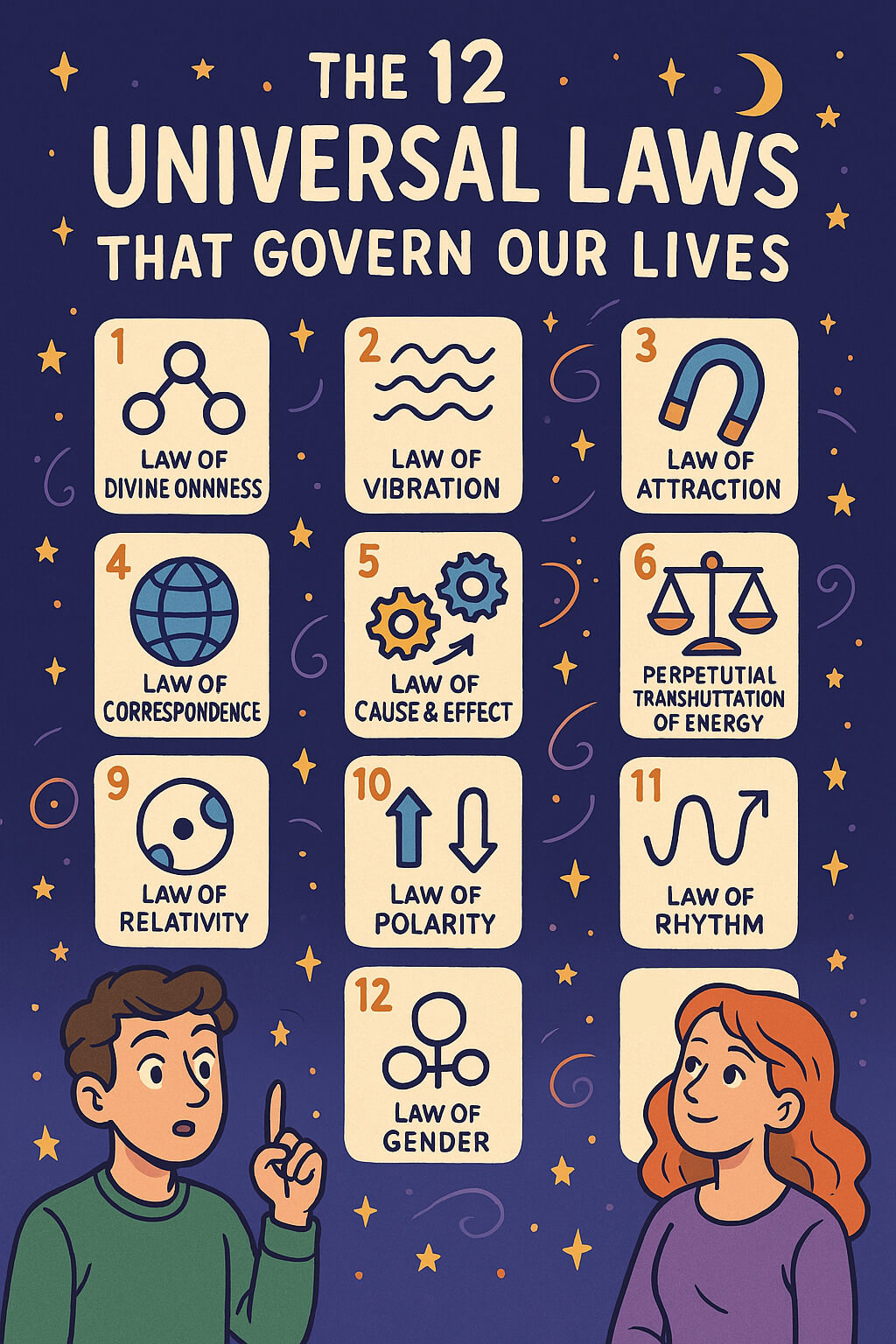
According to many spiritual and metaphysical traditions, life is not simply a series of random events. It unfolds through principles often referred to as the 12 Universal Laws.
These laws are commonly used as frameworks for understanding the relationship between your thoughts, beliefs, emotions, choices, actions, and experiences. Whether you approach them from a spiritual perspective, a manifestation perspective, or simply as tools for personal growth, they can encourage you to become more aware of the patterns shaping your life.
The important question is not whether you can control everything that happens to you.
You cannot.
But you can become more conscious of how you respond, what you focus on, the meaning you give to your experiences, and the actions you take.
That is where personal power begins.
Let’s explore the 12 Universal Laws and how you can apply them to your mindset, manifestation practice, success, relationships, and personal growth.
1. The Law of Divine Oneness
The Law of Divine Oneness teaches that everything is connected.
In spiritual traditions, this principle suggests that people, nature, experiences, and life itself are part of a greater whole. From this perspective, your thoughts and actions do not exist in complete isolation. The way you treat yourself can influence how you treat others, and the energy you bring into a situation can influence the atmosphere around you.
Think about it.
A person who enters a room angry can affect everyone around them. A person who brings encouragement, confidence, or kindness can also influence the people they encounter.
You do not have to view this as a mysterious force to recognize the practical value of the principle: your choices create ripple effects.
This law can also shift the way you approach success.
Instead of seeing everyone as competition, you can begin looking for opportunities to collaborate, contribute, and create value. Helping another person does not automatically guarantee that you will receive something in return, but building strong relationships, contributing value, and treating people well can create opportunities that isolation rarely does.
How to apply the Law of Divine Oneness
Practice becoming more aware of your connection with the world around you.
Ask yourself:
- How do my actions affect other people?
- What energy am I bringing into this situation?
- Am I acting from fear and separation or from contribution and cooperation?
- How can I create a positive ripple effect today?
Gratitude, kindness, and compassion are simple ways to practice this principle.
The more conscious you become of your impact, the more intentional your choices can become.
2. The Law of Vibration
The Law of Vibration is one of the most popular concepts in manifestation teachings.
According to this framework, everything is constantly in motion and has its own energetic state or vibration. In manifestation and spiritual traditions, your dominant emotional and mental state is often associated with the experiences you notice, pursue, and allow into your life.
This does not mean you must feel positive every second of the day.
That would be unrealistic.
Everyone experiences disappointment, fear, frustration, and uncertainty. The goal is not to suppress those emotions. The goal is to avoid becoming permanently identified with them.
If your mind repeatedly focuses on failure, lack, rejection, and worst-case scenarios, those patterns can influence your decisions. You may hesitate to take opportunities, overlook possibilities, or give up before making a serious attempt.
On the other hand, cultivating emotions such as gratitude, hope, confidence, and appreciation can help you approach life from a more empowered state.
How to raise your vibration in a practical way
Many manifestation practitioners use activities that help them consciously shift their emotional state, including:
- Practicing gratitude
- Meditating
- Spending time in nature
- Listening to uplifting music
- Exercising or moving the body
- Reducing exposure to constant negativity
- Surrounding themselves with encouraging people
- Visualizing a desired future
The goal is not to pretend that problems do not exist.
It is to avoid allowing your problems to become your permanent identity.
3. The Law of Attraction
The Law of Attraction is perhaps the best-known of the 12 Universal Laws.
In manifestation teachings, it is commonly summarized with the phrase: like attracts like.
The basic idea is that your dominant thoughts, beliefs, emotions, and expectations influence what you focus on and the direction of your life.
If you constantly tell yourself, “Nothing ever works for me,” you may begin looking for evidence that confirms that belief.
If you instead begin asking, “What can I do? What opportunities are available? What is the next step?” you may start noticing possibilities that previously received little attention.
This is where the Law of Attraction becomes more powerful when combined with personal responsibility.
Simply wanting something is not the same as creating it.
You can visualize financial success, but you still need to learn, make decisions, create value, develop skills, manage your money, or take other meaningful steps toward your goal.
Visualization and affirmations can be useful tools because they help you repeatedly focus on the direction you want to move toward.
Imagine the life you want to create.
See the details.
Connect with the emotions associated with achieving your goal.
Then ask the most important question:
What action would a person committed to this vision take next?
That question leads directly to the next Universal Law.
4. The Law of Action
The Law of Action reminds us that intention must eventually be followed by action.
You can read every manifestation book in the world.
You can create a vision board.
You can repeat affirmations every morning.
But if nothing changes in your behavior, your results may remain the same.
Action is the bridge between where you are and where you want to go.
However, the goal is not endless activity.
Being busy does not necessarily mean you are making progress.
Aligned action means taking steps that are connected to your actual goal.
If you want to build wealth, your actions might include developing valuable skills, improving your financial knowledge, starting a business, creating content, building professional relationships, or exploring additional income opportunities.
If you want to improve your health and wellbeing, your actions may involve building healthier routines.
If you want a different life, eventually you must do something differently.
Start with small actions
Do not wait until you have the perfect plan.
Ask yourself:
What is one meaningful action I can take today?
Small actions repeated consistently can create significant changes over time.
The Law of Action is a reminder that manifestation is not necessarily about sitting still and waiting for life to change.
Sometimes the opportunity you have been asking for begins with a decision you have been avoiding.
5. The Law of Correspondence
The Law of Correspondence is often associated with the phrase:
“As within, so without.”
According to spiritual teachings, your external experiences can reflect patterns that also exist within your beliefs, expectations, habits, and self-image.
This does not mean that you are personally responsible for every difficult event that happens in your life. Life is more complicated than that.
However, your internal world can influence your choices and responses.
For example, if someone deeply believes they are incapable of success, they may avoid challenges that could help them grow. If they believe opportunities are always dangerous or unavailable, they may be less likely to pursue them.
Changing your external circumstances often requires changing something internally as well.
That could be:
- A limiting belief
- A negative expectation
- A destructive habit
- A fear of failure
- A poor self-image
- An unconscious pattern of self-sabotage
Pay attention to recurring patterns.
If the same type of challenge keeps appearing in different forms, it may be worth asking:
What am I doing, believing, tolerating, or repeating that may be contributing to this pattern?
Awareness creates the opportunity for change.
6. The Law of Cause and Effect
The Law of Cause and Effect is built around a simple principle: actions and decisions have consequences.
Your current circumstances may be influenced by countless factors, some within your control and some outside of it.
But your choices still matter.
If you want different results, you often need different inputs.
You cannot expect to build financial security while repeatedly ignoring your finances. You cannot develop a new skill without spending time learning. You cannot build a stronger business while refusing to make decisions.
This law encourages you to move away from helplessness.
Instead of constantly asking:
“Why is this happening to me?”
Try asking:
“What can I influence from here?”
That question puts your attention on your available choices.
You may not control the entire situation.
But you may control your next move.
And sometimes your next move can change everything.
7. The Law of Compensation
The Law of Compensation is often connected with the idea that value and contribution can lead to reward.
From a practical perspective, this principle is especially relevant to wealth creation.
People and businesses are often compensated because they solve problems, provide skills, create products, offer services, or make life easier for others.
If you want to increase your income, one useful question is:
How can I become more valuable to the marketplace or to the people I serve?
That does not mean every good action will immediately produce financial rewards. Life does not operate like a vending machine where every positive action guarantees an identical return.
However, developing useful skills and consistently creating value can expand your opportunities.
You can apply this principle by focusing on:
- Solving real problems
- Improving your skills
- Creating useful products or services
- Helping others achieve meaningful outcomes
- Building trust
- Becoming reliable and consistent
The desire for wealth becomes more practical when you connect it with value creation.
Instead of only asking, “How can I get more?”
Also ask:
“What can I create, improve, solve, or contribute?”
8. The Law of Perpetual Transmutation of Energy
The Law of Perpetual Transmutation of Energy teaches that energy is constantly changing and transforming.
In manifestation traditions, this principle is often used as a reminder that your current state does not have to become your permanent state.
A setback can become a lesson.
A failure can become experience.
Fear can become preparation.
Confusion can become clarity.
The situation may not change instantly, but your relationship with it can change.
Imagine receiving disappointing news.
You could spend weeks repeating the same story and reinforcing the same emotional state.
Or you could acknowledge the disappointment and then ask:
What can I learn from this? What can I change? What can I do next?
That shift does not erase the problem.
But it can transform your response.
Meditation, reflection, movement, journaling, visualization, and focused action can all be used to help you move from one state into another.
You are not required to remain where you are mentally simply because that is where you started.
9. The Law of Relativity
The Law of Relativity teaches that experiences are often understood through comparison and perspective.
What one person sees as a major obstacle may appear manageable to another person with different experiences, resources, or expectations.
This does not mean your struggles are unimportant.
It means your interpretation of a challenge can influence how you respond to it.
When you encounter a difficult situation, try changing the questions you ask.
Instead of:
“Why is this happening?”
Try:
- What can this situation teach me?
- What opportunity might exist here?
- Will this still matter a year from now?
- What is within my control?
- What would happen if I viewed this as a challenge rather than a catastrophe?
Perspective does not solve every problem.
But it can prevent a temporary challenge from becoming a permanent mental prison.
10. The Law of Polarity
The Law of Polarity suggests that opposites exist along a spectrum.
We understand light partly because we understand darkness. We understand success partly because we have experienced setbacks. We recognize confidence because we also know doubt.
This principle can be especially useful when you are going through a difficult period.
A challenging situation may contain information about what you want instead.
If you dislike your current job, you may gain greater clarity about the type of work you truly want.
If you experience financial stress, you may become more motivated to improve your financial knowledge.
If a goal fails, you may discover weaknesses in your strategy that need to be addressed.
The challenge is to avoid becoming obsessed with the unwanted condition.
Ask yourself:
What is the opposite of what I do not want?
Then focus your attention on moving in that direction.
You may not transform your circumstances overnight, but you can begin changing your direction.
11. The Law of Rhythm
Life moves in cycles.
There are periods of momentum, growth, rest, challenge, learning, expansion, and renewal.
The Law of Rhythm encourages you to recognize these changing seasons rather than assuming every difficult period will last forever.
Sometimes you will feel highly motivated.
Sometimes you will not.
Sometimes a business will grow quickly.
Sometimes progress will feel slow.
Sometimes you will have clarity.
Sometimes you will need time to rethink your direction.
The mistake is believing that a temporary downturn defines your future.
Instead of abandoning your goals every time momentum slows, use quieter periods to reflect, learn, recover, and prepare.
The rhythm will change.
Your responsibility is to remain conscious enough to respond wisely when it does.
Consistency is especially important during periods when motivation disappears.
You do not always need to make massive progress.
Sometimes maintaining your habits is enough.
12. The Law of Gender
The Law of Gender, as described in many spiritual traditions, is not primarily about biological sex.
Instead, it is often associated with complementary qualities sometimes described as masculine and feminine energies.
The active, focused, decisive, and action-oriented qualities are commonly described as masculine.
The receptive, intuitive, creative, and allowing qualities are commonly described as feminine.
From a personal-development perspective, the value of this framework is balance.
There are times to plan.
And there are times to act.
There are times to push forward.
And there are times to pause and reflect.
There are times to use logic.
And times when creativity and intuition can help you see possibilities that pure analysis may overlook.
You do not need to force every result.
But you also cannot remain passive and expect everything to happen for you.
The goal is to develop both capacities: the ability to receive ideas, opportunities, and inspiration—and the discipline to turn them into action.
Bringing the 12 Universal Laws Into Your Daily Life
Understanding the 12 Universal Laws is only the beginning.
The real value comes from applying the principles that resonate with you.
You can begin with a simple daily practice:
1. Observe your thoughts
Notice the ideas you repeat most often. Are they helping you move toward your goals, or keeping you focused on what you fear?
2. Choose your emotional direction
You cannot control every emotion, but you can develop practices that help you return to a more grounded, empowered state.
3. Visualize what you want
Create a clear mental picture of the future you want to build. Focus on what you want rather than repeatedly feeding attention to what you fear.
4. Identify one limiting pattern
Look for a belief, habit, or recurring behavior that may be holding you back.
5. Take one aligned action
Every day, do something connected to the life you want to create.
6. Reflect on setbacks differently
Instead of automatically labeling every challenge as failure, ask what it can teach you.
7. Stay committed to the long term
Life has rhythms. Progress will not always feel exciting, but consistent effort can continue even when motivation changes.
Final Thoughts: The Power of Becoming More Conscious
The 12 Universal Laws offer a framework for looking at life through the lenses of connection, focus, action, responsibility, transformation, perspective, balance, and growth.
You do not need to accept every interpretation of these laws as literal fact to benefit from the questions they encourage you to ask.
What are you focusing on?
What beliefs are shaping your decisions?
What patterns keep repeating?
Where do you need to take action?
What can you learn from your current circumstances?
And most importantly:
What kind of life are you consciously choosing to build?
Many manifestation teachings emphasize the importance of intention. Personal development emphasizes responsibility and action. Spiritual traditions often emphasize awareness.
When these ideas are combined, a powerful principle emerges:
Become conscious of your inner world, become intentional about your direction, and support your vision with meaningful action.
You may not control every event in life.
But you can develop greater awareness of how you think, what you believe, where you direct your attention, and what you choose to do next.
And that awareness may be one of the most powerful transformations of all.