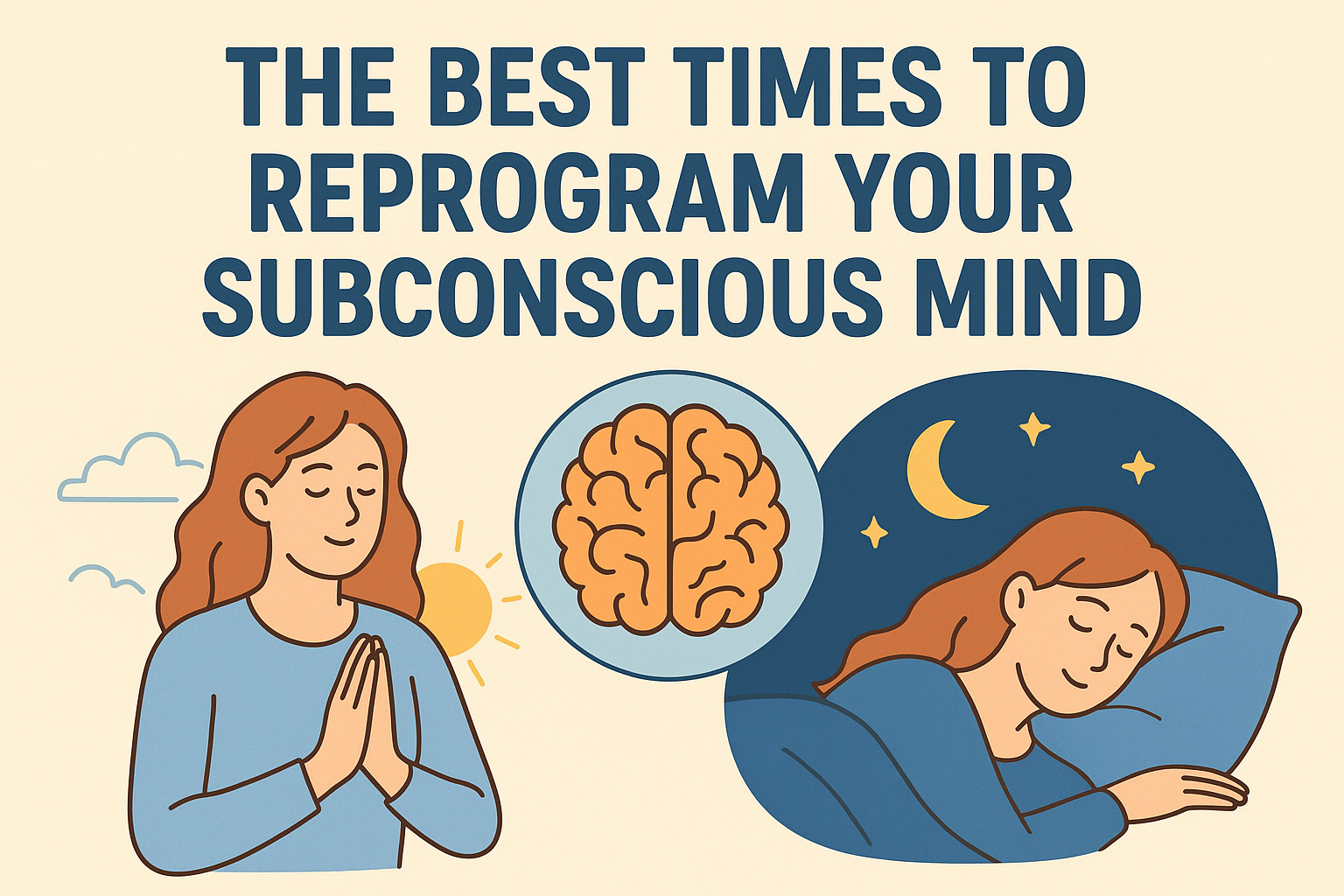
What if the first few minutes after you wake up and the final few minutes before you fall asleep could become the most intentional moments of your entire day?
Most people allow those moments to happen automatically.
They wake up, grab their phone, check messages, scroll through social media, think about everything they need to accomplish, and immediately fill their minds with outside information.
At night, they do the opposite. They spend the final moments of the day thinking about problems, watching stimulating content, worrying about tomorrow, or replaying everything that went wrong.
Then they wonder why the same thoughts, habits, fears, and limitations seem to follow them day after day.
From a manifestation and personal-development perspective, what you repeatedly give your attention to becomes part of the mental environment from which your decisions, expectations, and actions emerge.
That is why two moments deserve special attention:
First thing in the morning.
And:
Right before you go to sleep.
These transitional periods are naturally quieter. Your attention is less occupied with the demands of the day, making them excellent opportunities for meditation, visualization, affirmations, gratitude, scripting, and other forms of intentional mental programming.
Many manifestation practitioners also associate the morning with the Alpha state and the period before sleep with Theta activity. Whether you view these brainwave states through a spiritual, personal-development, or simply practical lens, the underlying principle is powerful:
Be deliberate about the thoughts you repeatedly rehearse.
Let’s explore how to use these two daily windows to create a more empowering mental blueprint.
Why the Subconscious Mind Matters
Your conscious mind is the part of you that deliberately thinks, analyzes, evaluates, compares, and makes decisions.
Your subconscious mind is often used as a broader term for the mental processes operating outside your immediate awareness—including learned patterns, automatic responses, emotional associations, and deeply practiced habits.
Think about how you learned to perform something that once required enormous concentration.
Driving.
Typing.
Walking.
Playing an instrument.
At first, you have to consciously think about each step. With repetition, much of the process becomes automatic.
This is an important principle for personal transformation.
The beliefs you repeatedly rehearse can influence the way you interpret experiences, what you expect from yourself, which opportunities you notice, and how you respond to challenges.
If you repeatedly tell yourself:
“I’m not capable.”
“I’ll never have enough money.”
“People like me don’t succeed.”
“It’s too late for me.”
those statements can become familiar mental patterns.
But the same principle can be used in a more constructive direction.
You can deliberately rehearse thoughts such as:
“I am capable of learning new skills.”
“I recognize opportunities and take intelligent action.”
“I am becoming more confident every day.”
“I am building a prosperous and meaningful life.”
This is where intentional subconscious reprogramming becomes useful.
Your goal isn’t to magically force reality to obey a sentence.
Your goal is to repeatedly expose your mind to a new direction until that direction becomes increasingly familiar—and then support it with choices and actions.
The Power of Transitional States
Your mental state changes throughout the day.
When you’re working, solving problems, answering messages, studying, or dealing with responsibilities, your attention is generally directed outward.
But there are natural transitions when your mind becomes quieter.
Two of the most interesting are:
- The period immediately after waking
- The period immediately before falling asleep
These aren’t magical guarantees, and you don’t need to obsess over exact brainwave frequencies.
Instead, think of them as mental transition windows.
You’re moving from one state of consciousness into another, and these periods can provide a valuable opportunity to step away from automatic thinking and deliberately choose what you want to focus on.
Many meditation and manifestation traditions associate relaxed states with Alpha and Theta brainwave activity. These states are also commonly discussed in connection with relaxation, meditation, imagery, and the transition between wakefulness and sleep.
For manifestation purposes, the practical lesson is simple:
Use the quiet moments when your mind is naturally less distracted.
The Morning Alpha Window
Imagine waking up tomorrow morning and refusing to immediately hand your attention over to the outside world.
No news.
No social-media arguments.
No endless notifications.
No checking what everyone else is doing.
Instead, you spend the first few minutes deciding what you want your mind to focus on.
This is the basic idea behind using the morning as a subconscious reprogramming opportunity.
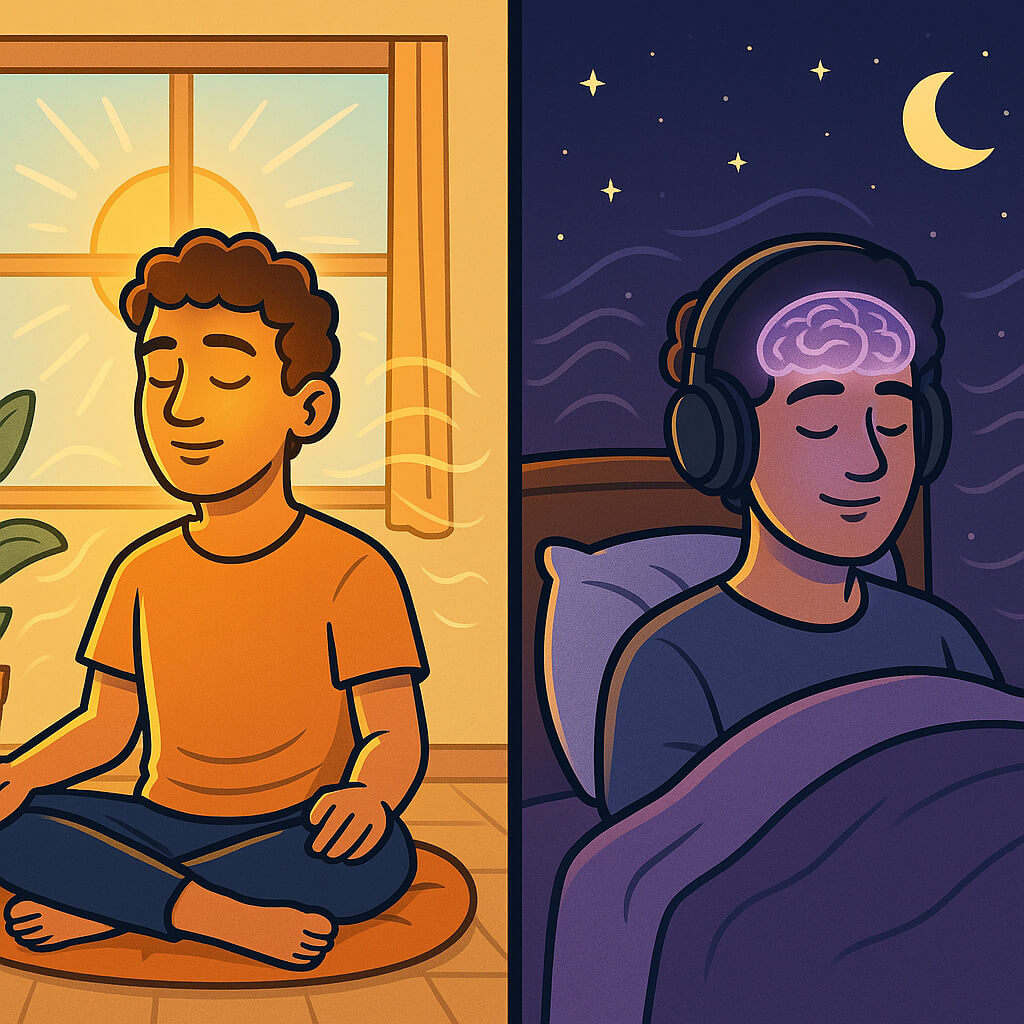
As you transition from sleep into wakefulness, you may feel relaxed, dreamy, or mentally quiet. This is often associated with Alpha activity and can make the morning an excellent time for meditation, visualization, affirmations, and intention-setting.
You don’t need an elaborate 60-minute routine.
You can begin with five or ten minutes.
1. Begin With Gratitude
Before thinking about everything you don’t have, consciously recognize what you already have.
Think of three things you’re genuinely grateful for.
They don’t have to be extraordinary.
Your health.
Your family.
A comfortable bed.
An opportunity.
A lesson you’ve learned.
A person who helped you.
The ability to start another day.
Gratitude changes the direction of your attention.
Instead of beginning the morning by asking, “What’s wrong?”, you begin by asking:
“What’s already going right?”
That is a very different mental starting point.
2. Choose Your Mental Programming
Now decide what you want to reinforce.
If your goal is financial growth, you might focus on abundance, discipline, opportunity, creativity, and intelligent decision-making.
If your goal is personal growth, you might focus on confidence, patience, courage, and consistency.
If your goal is manifestation, you might focus on the feeling and identity associated with your desired future.
For example:
“I am becoming the kind of person who recognizes and acts on valuable opportunities.”
That statement is powerful because it connects your mindset to behavior.
3. Visualize Your Desired Future
Close your eyes.
Picture yourself several months or years from now.
What does your life look like?
What are you working on?
How do you spend your time?
What kind of person have you become?
Most importantly, don’t merely visualize an object.
Visualize the experience.
Imagine the confidence of reaching an important goal.
Imagine the satisfaction of becoming financially responsible.
Imagine waking up knowing you’re making meaningful progress.
Visualization gives your mind a direction to rehearse.
And when you combine visualization with real-world action, it becomes much more useful than simply wishing for an outcome.
4. Set an Intention for the Day
Before leaving your morning routine, choose one intention.
It could be:
“Today I will act with confidence.”
“Today I will look for opportunities instead of problems.”
“Today I will take one meaningful step toward financial freedom.”
“Today I will protect my attention.”
One clear intention can influence the decisions you make throughout the day.
Why the First Minutes Matter
There’s another practical reason to protect your morning.
Your first input often determines what receives your attention next.
If you begin with an alarming headline, an argument, a stressful email, and hundreds of notifications, your attention immediately becomes reactive.
If you begin with quiet reflection, gratitude, visualization, and intention, you’re choosing your direction before the outside world chooses it for you.
That’s a powerful habit regardless of whether you interpret it through neuroscience, spirituality, manifestation, or personal development.
Own the first few minutes of your day.
Don’t automatically give them away.

The Nighttime Theta Window
Now we come to the other powerful opportunity: the moments before sleep.
As you become increasingly relaxed and move toward sleep, your mental activity changes. Theta activity is commonly associated with drowsiness, dreaming, and certain stages of sleep.
Manifestation traditions have long emphasized the importance of the thoughts and images held immediately before sleep.
Why?
Because instead of ending the day in a state of mental chaos, you can deliberately choose the final ideas you want to contemplate.
Think of your mind as a garden.
What do you want to plant before the lights go out?
Fear?
Regret?
Stress?
Or gratitude, possibility, confidence, and a compelling vision of the future?
1. Review the Day
Take a few minutes to reflect.
What went well?
What did you learn?
Where did you make progress?
What are you proud of?
Even if the day wasn’t perfect, find something positive.
You are training your attention to recognize progress instead of constantly searching for evidence of failure.
2. Release the Day
You don’t need to solve tomorrow tonight.
If something went wrong, acknowledge it.
Learn from it.
Then mentally place it aside.
Tell yourself:
“Today is complete. Tomorrow is a new opportunity.”
This simple ritual can help create a cleaner transition into sleep.
3. Repeat Your Affirmations
Choose a small number of affirmations that support the identity you want to develop.
For example:
“I am becoming more confident every day.”
“I am open to new opportunities.”
“I trust myself to make wise decisions.”
“I am building greater financial freedom through consistent action.”
Keep them simple.
Don’t rush.
Let the words become emotionally meaningful rather than mechanically repeating them dozens of times.
4. Visualize Before Sleep
Now picture your desired future.
Don’t worry about making the image perfect.
Simply allow your imagination to construct a scene that represents your goal.
If you’re working toward financial success, perhaps imagine yourself reviewing a successful project, feeling proud of your progress, or enjoying greater freedom because you’ve built something valuable.
If you’re pursuing personal growth, imagine yourself behaving with the confidence and discipline you’ve been developing.
The objective is to create a clear mental picture of the person you’re becoming.
5. End With Gratitude
Finish your day the same way you started it.
With gratitude.
Think of three things.
Then let yourself relax.
This creates a beautiful rhythm:
Morning: choose the direction.
Daytime: take action.
Night: reinforce the direction.
Repeat.
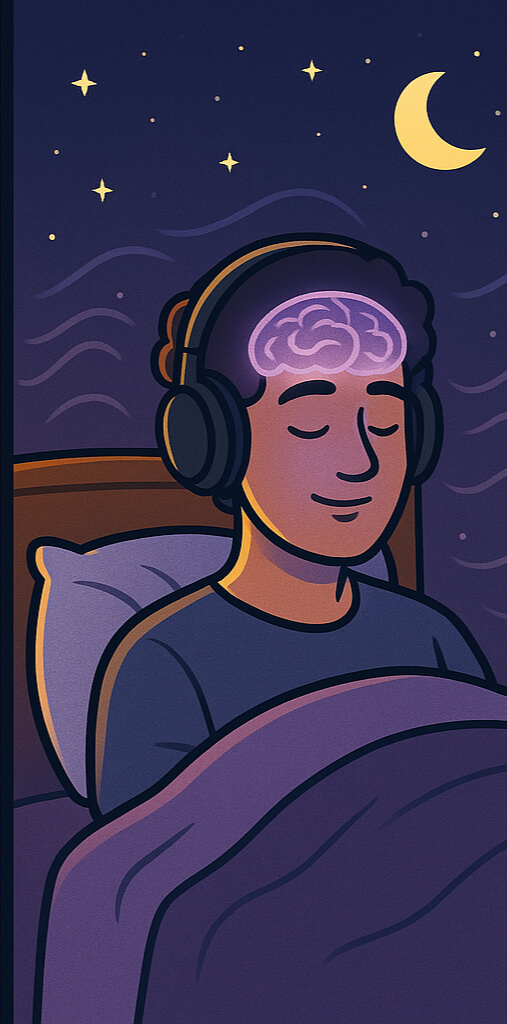
Morning and Night: Your Simple Reprogramming Routine
You don’t need to spend hours doing this.
Try this simple routine.
Morning — 10 Minutes
2 minutes: Gratitude
3 minutes: Affirmations
3 minutes: Visualization
2 minutes: Daily intention
Then get up and take action.
Night — 10 Minutes
2 minutes: Reflect on your day
2 minutes: Release worries
3 minutes: Affirmations
3 minutes: Visualization and gratitude
Then allow yourself to sleep naturally.
The key isn’t complexity.
It’s consistency.
What About Subliminal Audio and Brainwave Programs?
Some people incorporate guided meditations, affirmations, subliminal-style recordings, or brainwave audio programs into their morning or nighttime routines.
These can be viewed as tools for creating a consistent mental environment.
If you choose to use them, the most important factor is whether they help you maintain a calm, focused, and intentional routine.
For example, you might use a manifestation audio while meditating in the morning or a relaxation-focused recording before bed.
The goal isn’t to become dependent on a particular recording.
The goal is to create a repeatable practice that keeps your attention aligned with the beliefs and goals you want to cultivate.
You can also explore our guide to brainwave manifestation and sound frequencies to learn more about how these concepts are used within manifestation practices.
Don’t Make This Common Mistake
One of the biggest mistakes people make with subconscious reprogramming is expecting immediate results.
They repeat an affirmation for three days and think:
“Nothing happened.”
Then they quit.
But changing a deeply practiced mental pattern is rarely about one spectacular session.
It’s about repetition.
Think about learning a new language.
You don’t study five words once and expect to speak fluently forever.
You practice.
You repeat.
You use the words.
Eventually, they become familiar.
The same principle applies to mental habits.
Give yourself time.
More importantly, give your new programming evidence through your actions.
If you affirm that you’re becoming financially successful but continue making careless financial decisions, the affirmation isn’t enough.
If you affirm that you’re confident but consistently avoid every opportunity to challenge yourself, the affirmation isn’t enough.
The most powerful combination is:
New thought + repeated practice + aligned action.
The Real Secret: Program Your Mind, Then Prove It
This is where manifestation becomes practical.
Don’t use subconscious reprogramming as a substitute for action.
Use it to support action.
If you’re manifesting wealth, learn valuable skills.
Build something useful.
Improve your financial habits.
Look for opportunities.
If you’re manifesting success, become more disciplined.
If you’re manifesting confidence, take small courageous actions.
If you’re manifesting a better life, start behaving like someone who is actively creating it.
Your morning visualization gives you the destination.
Your daytime actions move you toward it.
Your nighttime reflection reinforces the journey.
That is how a spiritual practice becomes a practical lifestyle.
What Should You Think About Before Sleep?
This is one of the simplest questions you can ask yourself every night:
“If I could choose the final thought of my day, what would I want it to be?”
Not fear.
Not yesterday’s mistake.
Not tomorrow’s imaginary disaster.
Choose something that represents the person you’re becoming.
Perhaps:
“I am grateful for how far I’ve come.”
“I trust myself to keep moving forward.”
“I am creating a prosperous and meaningful future.”
“Tomorrow gives me another opportunity to grow.”
Then let it go.
You don’t have to force anything.
You don’t have to obsess over whether manifestation is working.
Relax.
Sleep.
Wake up.
And begin again.
Final Thoughts: Program Your Mind at Both Ends of the Day
You don’t have to control every thought you have.
You don’t need to spend your entire day repeating affirmations.
And you certainly don’t need to turn manifestation into another source of pressure.
Instead, start with two simple windows.
Morning.
Before the noise of the world enters your mind, decide what you want to focus on.
Use gratitude, affirmations, visualization, meditation, and intention-setting to establish the direction of your day.
Night.
Before you surrender to sleep, release the day’s distractions and deliberately focus on gratitude, your desired future, and the identity you’re building.
Many manifestation teachings associate the relaxed morning period with Alpha and the transition toward sleep with Theta. You can explore the difference between Alpha and Theta waves as part of your deeper understanding of these practices.
But don’t get trapped in the terminology.
The real opportunity is much simpler.
Become intentional about what you repeatedly think, feel, imagine, and practice.
Morning plants the seed.
Your actions throughout the day give it energy.
Night gives you another opportunity to reinforce the vision.
Do this consistently, patiently, and with purpose.
Because the goal isn’t simply to think differently.
The goal is to become different—to develop new expectations, new habits, new responses, and a new relationship with your own potential.
And that transformation can begin with something as simple as the first few minutes after you wake up and the final few minutes before you close your eyes.