
There is a little-known secret that sThe Power of Giving: How Giving Activates the Law of Attraction
What if one of the most powerful ways to attract more abundance is not to focus on getting—but to learn how to give?
Most people are conditioned to believe that they must first have more before they can afford to be generous. They tell themselves:
“When I make more money, I’ll give more.”
“When I become successful, I’ll help others.”
“When I finally have enough, then I can afford to be generous.”
But according to many spiritual traditions and manifestation teachings, this way of thinking can keep you trapped in the very mindset you are trying to escape.
The power of giving begins with a different idea: abundance flows.
When you constantly hold onto everything because you are afraid of losing it, you may reinforce a mindset of scarcity. However, when you learn to give wisely, joyfully, and within your means, you can begin shifting your relationship with money, abundance, gratitude, and possibility.
Giving does not mean becoming reckless with money. It does not mean giving away what you need to survive. And it certainly does not mean expecting the universe to immediately reward you with a specific amount of money.
Instead, giving can become a powerful practice for developing an abundance mindset.
According to manifestation teachings, the energy, intention, and beliefs behind your actions matter. When you give from a place of gratitude rather than fear, many practitioners believe you send a powerful message to yourself and to the universe:
“There is enough. I am grateful for what I have. And I trust that abundance can continue to flow into my life.”
That shift can change more than the way you give. It can change the way you think, feel, act, and recognize opportunities.
The Secret Behind Giving and Receiving
Giving and receiving are often described as two sides of the same energetic cycle.
Think about breathing. You cannot inhale forever. Eventually, you must exhale before you can breathe in again. In the same way, life involves a continuous exchange of giving and receiving.
Love is given and received.
Knowledge is shared and received.
Support moves from one person to another.
Money circulates through individuals, businesses, families, and communities.
From a manifestation perspective, this circulation matters because it challenges the belief that abundance is something you must desperately protect at all costs.
Of course, being financially responsible is important. Saving money, paying your bills, and planning for the future are not signs of scarcity. The problem begins when fear becomes the dominant force behind every financial decision.
If you constantly think:
“I can never afford to give.”
“If I spend anything, there will never be enough.”
“I have to hold onto everything because nothing else will come.”
You may unintentionally strengthen a scarcity-based relationship with money.
Giving, even in small and responsible ways, can become a practice in shifting that perspective.
You are reminding yourself that you have something to share.
That does not mean you need to be wealthy.
You can give your time.
You can share knowledge.
You can offer encouragement.
You can help someone solve a problem.
And when you choose to give money, you can do so wisely and within your financial limits.
The important principle is this: giving should come from abundance, not desperation.
Giving Creates Space for a New Relationship With Abundance
One of the most popular metaphors in manifestation teachings is the idea of creating space.
Imagine holding a closed fist.
Nothing can leave it—but nothing new can enter it either.
Now imagine opening your hand.
You are no longer gripping everything out of fear.
You are allowing movement.
This is how many people view the spiritual principle of giving and receiving.
When you give, you practice letting abundance circulate rather than treating it as something that must remain frozen in place.
This does not guarantee that every donation will result in an immediate financial windfall. Life does not operate like a vending machine where you insert money and expect the universe to return a larger amount.
However, giving can create meaningful changes within you.
It can increase gratitude.
It can help you focus on what you already have instead of obsessing over what you lack.
It can strengthen your sense of connection with other people.
And it can encourage you to see yourself as someone who has value and resources to contribute.
These internal changes can influence the way you approach opportunities, relationships, business, and personal growth.
According to manifestation teachings, that internal shift is where the real transformation often begins.
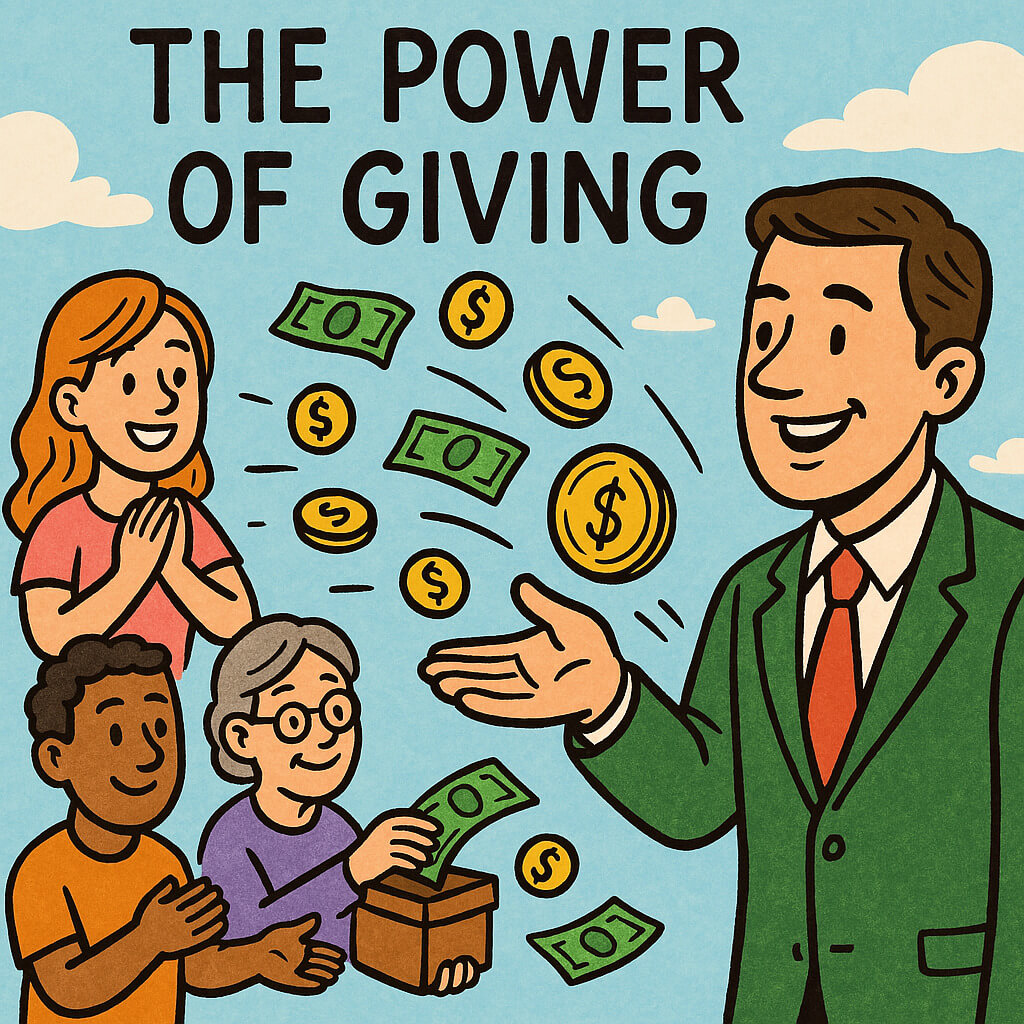
What Should You Give?
One of the biggest misunderstandings about generosity is the belief that giving only means giving money.
Money is only one form of giving.
In fact, depending on your circumstances, another form of generosity may be even more valuable.
Give Your Time
Time is one of your most valuable resources.
You might help someone with a project, volunteer for a meaningful cause, mentor another person, or simply be present when someone needs support.
A few minutes of genuine attention can sometimes mean more than an expensive gift.
Give Love and Kindness
A sincere compliment.
A word of encouragement.
A message to someone who is struggling.
A simple act of patience.
These things may appear small, but they can have a powerful ripple effect.
Giving kindness also changes your own emotional state. Instead of focusing entirely on your problems, you temporarily shift your attention toward contributing something positive.
Give Knowledge
If you know something that could help another person, share it.
Teach what you have learned.
Recommend a useful resource.
Help someone avoid a mistake you once made.
The more you develop yourself, the more valuable knowledge you may eventually have to contribute.
Give Energy and Effort
Sometimes generosity means going slightly beyond what is expected.
Helping someone solve a problem.
Introducing two people who could benefit from knowing each other.
Supporting a friend’s new business.
Making an effort to improve someone’s day.
These actions can strengthen relationships and create opportunities for positive reciprocity.
Give Material Resources
This can include money, food, clothing, books, or other useful resources.
The amount is not always the most important factor.
A small gift given with genuine intention can be meaningful.
The goal is not to impress other people. The goal is to develop the habit of contribution.
The Ripple Effect of Giving
One act of generosity rarely ends with one person.
Imagine giving someone encouragement at exactly the moment they were ready to give up.
That person may feel inspired to continue.
Later, they may help someone else.
That person may then influence another individual.
A single positive action can create consequences you may never see.
This is the ripple effect of giving.
Many spiritual traditions teach that what you put into the world eventually becomes part of the environment you live in. Whether you view this as karma, energetic reciprocity, the Law of Attraction, or simply the natural consequences of human behavior, the principle remains powerful:
Your actions contribute to the world around you.
When you become someone who consistently looks for opportunities to contribute, you may also begin noticing opportunities that were previously invisible to you.
You start building stronger relationships.
People may remember your generosity.
You may develop a reputation for being helpful and trustworthy.
And from a manifestation perspective, you begin identifying more strongly with abundance rather than lack.
The Secret of Giving Away Money That Can Create Miracles
For many people, giving money is emotionally different from giving time or kindness.
Money often carries fear.
It represents security, freedom, comfort, and future possibilities.
That is why intentional financial giving can be such a powerful mindset practice.
However, there are three important principles to remember.
1. Let It Mean Something—Without Becoming Financially Reckless
Sometimes a meaningful gift requires you to choose between two options.
For example, you might decide to skip an unnecessary luxury, such as an expensive night out or a weekend of entertainment, and instead contribute that money to a cause or person you genuinely want to support.
This is different from giving away money you need for rent, food, bills, or other essential responsibilities.
A meaningful sacrifice should not become self-destruction.
The purpose is to consciously redirect resources—not to create financial hardship.
When you occasionally choose contribution over unnecessary consumption, you reinforce a powerful message:
“I can make intentional choices with my money.”
For many people, that act feels deeply empowering.
2. Give With a Cheerful Heart
The attitude behind giving matters.
If you give while feeling angry, resentful, manipulated, or pressured, the experience may reinforce negative emotions.
But giving voluntarily and joyfully can create a completely different internal experience.
In the Bible, the principle is expressed simply: “God loves a cheerful giver.”
The deeper lesson is about the heart behind the action.
Give because you want to contribute.
Give because the cause matters to you.
Give because helping another person brings you genuine satisfaction.
You do not have to announce your generosity.
You do not have to expect recognition.
And you do not have to keep score.
According to many manifestation teachings, giving without attachment creates a more powerful energetic experience because you are not constantly watching the universe and demanding payment in return.
You give.
You feel grateful.
And then you continue living your life.
3. Never Put Yourself Under Financial Pressure
This principle is essential.
Giving should not force you into debt, prevent you from paying essential expenses, or create unnecessary financial stress.
You do not have to give a large amount to practice generosity.
A small amount given consistently and intentionally may be more sustainable than one dramatic gesture that creates hardship.
You might choose a percentage of discretionary income.
You might set aside a small monthly amount.
Or you may decide to give whenever you genuinely have the financial space to do so.
The purpose is not to prove how much faith you have by ignoring reality.
True abundance includes responsibility.
Giving from a place of stability allows generosity to become a long-term practice rather than a source of anxiety.

Giving, Gratitude, and the Abundance Mindset
Gratitude and giving naturally support one another.
When you focus only on what you do not have, it can be difficult to feel generous.
But when you take time to recognize what is already present in your life, you may begin noticing that you have more to appreciate—and perhaps more to contribute—than you initially realized.
This does not mean pretending that financial problems do not exist.
It means refusing to allow your current circumstances to define your entire identity.
You may not have everything you want.
But you may still have something you can give.
A skill.
A smile.
An hour of your time.
A useful idea.
A small donation.
A connection.
A kind word.
That realization can shift your self-image from “I am someone who has nothing” to “I am someone who can contribute.”
And self-image is a central part of manifestation and personal development.
The way you see yourself influences the decisions you make.
Your decisions influence your actions.
And your repeated actions shape your results.
Why Giving Can Make You Feel Like a Money Magnet
According to manifestation teachings, people often become more attractive to abundance when they stop treating money as something to fear.
Giving can help transform your relationship with money from one of constant anxiety into one of conscious circulation.
When you become more generous, you may also become more focused on creating value.
And creating value is one of the most practical ways to improve your financial opportunities.
Ask yourself:
How can I help someone solve a problem?
How can I provide something useful?
How can I make another person’s life easier?
How can I become more valuable in my career, business, or community?
This is where spirituality and practical action can meet.
Giving does not replace hard work, financial planning, skill development, or intelligent decision-making.
Instead, generosity can support a mindset that encourages contribution and value creation.
The more value you learn to create, the more opportunities you may be able to recognize and pursue.
From a manifestation perspective, this can also strengthen your belief that abundance is not limited to a fixed amount of money.
Opportunities can be created.
Skills can be developed.
Relationships can expand.
New ideas can emerge.
And wealth can grow when value is exchanged.
The Spiritual Connection to Giving
The power of giving appears throughout spiritual traditions across the world.
In Christianity, charitable giving and generosity are closely connected with faith and service.
In Islam, charitable giving is an important spiritual practice.
In Hindu and Buddhist traditions, generosity and selfless service are often associated with spiritual development and compassion.
Although the traditions differ, a common principle appears repeatedly:
Life becomes more meaningful when we learn to look beyond ourselves.
Giving can remind you that success is not only about accumulation.
It is also about contribution.
What can you do with what you have?
How can your knowledge, resources, experience, or success benefit someone else?
For many people, these questions create a deeper form of abundance—one that cannot be measured only by a bank balance.
A 7-Day Giving Challenge
If you want to experience the power of giving for yourself, try this simple challenge.
For the next seven days, give something every day.
It does not need to be money.
Day 1: Give someone a genuine compliment.
Day 2: Help someone without being asked.
Day 3: Share useful knowledge or a valuable resource.
Day 4: Give your time to someone who needs support.
Day 5: Perform one anonymous act of kindness.
Day 6: If financially comfortable, give a small amount to a cause or person you care about.
Day 7: Reflect on the experience and write down what changed in your thoughts, emotions, and awareness.
As you complete the challenge, pay attention.
Do you feel more grateful?
Do you notice more opportunities to contribute?
Do you feel more connected to other people?
Do you begin seeing yourself differently?
According to manifestation teachings, these shifts in awareness can be the beginning of a deeper transformation.
Final Thoughts: Give, Then Let Go
The power of giving is not about trying to manipulate the universe.
It is not about donating money today because you expect a specific financial reward tomorrow.
And it is not about sacrificing your own wellbeing to prove your generosity.
The deeper lesson is about developing a new relationship with abundance.
Give when you can.
Give wisely.
Give intentionally.
Give with gratitude.
And whenever possible, give with a cheerful heart.
Allow abundance to become something that flows through your life rather than something you constantly grip out of fear.
Because when you begin to see yourself as someone who can contribute, create value, share, support, and give, you may start transforming the way you see yourself—and what you believe is possible.
According to many manifestation teachings, that is when the Law of Attraction begins to take on a deeper meaning.
You are no longer sitting back and waiting for abundance to arrive.
You are participating in the energy of abundance.
And sometimes, the first step toward receiving more is learning how to open your hand.