What if one of the most powerful tools for changing your life did not require expensive equipment, complicated rituals, or hours of preparation?
What if it began with something you are already doing right now?
Breathing.
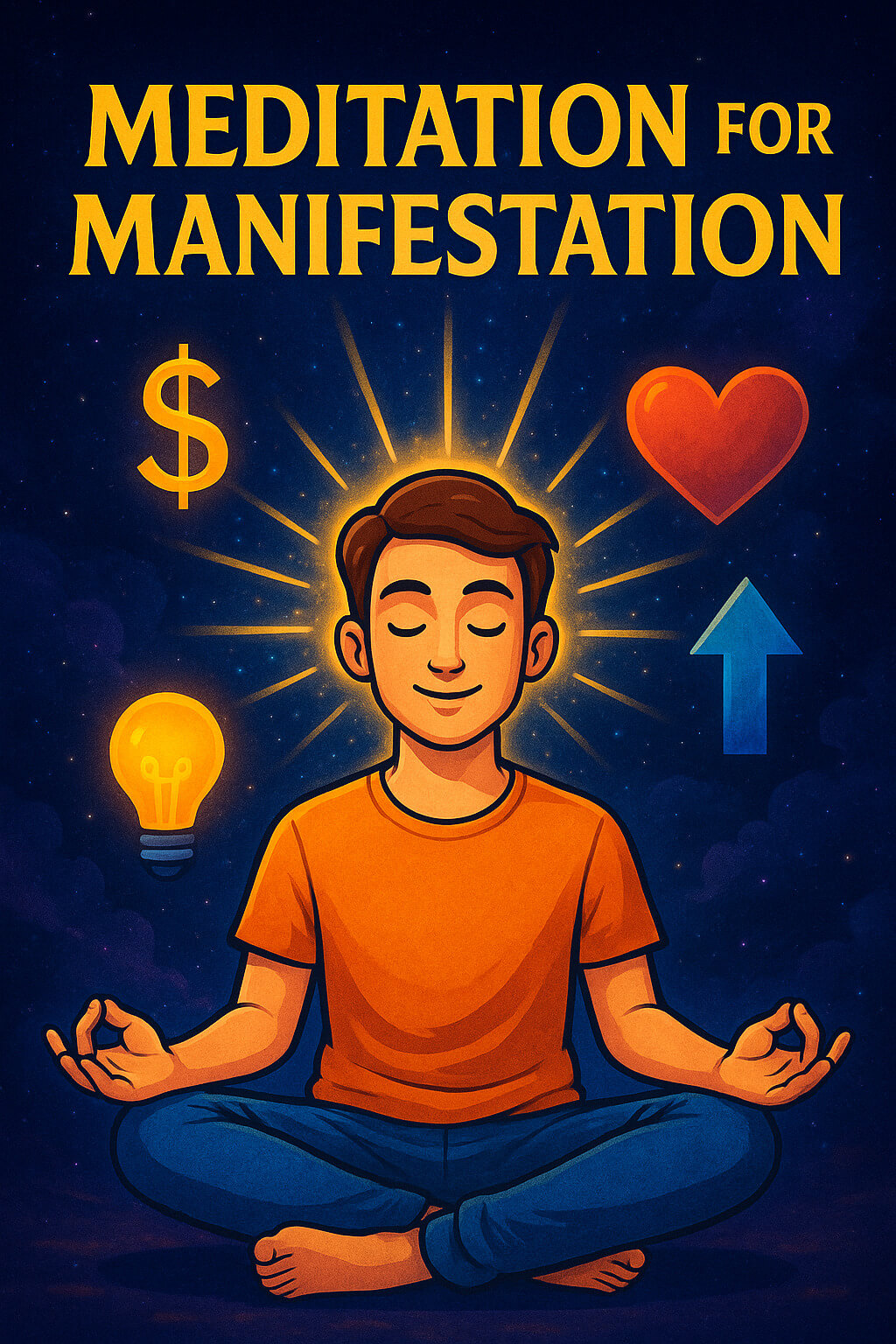
Meditation has been practiced for centuries as a way to cultivate stillness, awareness, emotional balance, and a deeper connection with oneself. Today, it is also widely used within manifestation and personal-development practices.
According to manifestation teachings, your outer life is strongly influenced by your inner world. The thoughts you repeatedly entertain, the emotions you reinforce, the beliefs you hold, and the identity you accept all shape the way you perceive opportunities and respond to life.
Meditation gives you an opportunity to step back from the constant noise.
It helps you become aware of the mental patterns that may be running automatically.
And that is where transformation can begin.
Meditation for manifestation is not about forcing yourself to think positive thoughts for 20 minutes. It is not about desperately trying to make money, love, or success appear.
Instead, it begins with learning how to become still.
When you regularly step away from distraction and observe your inner world, you may become more aware of fear, doubt, limiting beliefs, and repetitive thought patterns. With practice, you can learn not to become controlled by every thought that enters your mind.
Many manifestation practitioners believe this creates a more powerful foundation for consciously choosing the beliefs, emotions, and intentions you want to cultivate.
The question is simple:
Are you willing to spend a little time each day mastering the most important environment you will ever live in—your own mind?
Why Meditation Can Support Manifestation
Your life is not created by one thought.
It is influenced by repeated patterns.
If you constantly think, “Nothing ever works out for me,” you may begin approaching opportunities from a place of discouragement. If you believe you are incapable of success, you may hesitate, procrastinate, or give up before giving yourself a real chance.
On the other hand, changing your inner state can change how you see yourself and how you respond to the world around you.
This is one reason meditation fits naturally into manifestation and personal development.
Meditation creates space between you and your thoughts.
Instead of immediately reacting to fear, frustration, or self-doubt, you can learn to notice what is happening internally.
That awareness matters.
You cannot easily change a pattern you never notice.
According to manifestation teachings, meditation may also help you become more aligned with the feeling of the life you want to create. Rather than constantly operating from stress, lack, desperation, or fear, you can practice returning to a calmer and more intentional state.
In spiritual traditions, this inner shift is often described as raising your vibration or changing your frequency.
Whether you interpret that language spiritually or simply as a change in your emotional and mental state, the practical principle remains useful:
Your inner world influences the way you experience and respond to your outer world.
Meditation gives you a daily opportunity to work on that inner world.
The Benefits of Meditation
Meditation is often associated with relaxation, but its potential benefits can extend much further.
Different people experience meditation differently, and the effects may depend on the type of practice, consistency, lifestyle, and individual circumstances. However, many people use meditation to support physical relaxation, emotional balance, mental clarity, and personal growth.
Physical and Physiological Benefits
A regular meditation practice may support your overall sense of physical well-being.
Many people find that meditation helps them:
- Feel more relaxed and less physically tense.
- Support healthier stress management.
- Improve their ability to unwind.
- Sleep more peacefully.
- Become more aware of how stress affects their body.
- Develop a greater sense of balance and calm.
Stress can influence many aspects of daily life. When your mind is constantly racing, your body may also remain in a state of tension.
Meditation creates a deliberate pause.
It gives you permission to slow down.
For many people, that simple shift can become an important part of maintaining a healthier and more balanced lifestyle.
Meditation should not be viewed as a replacement for appropriate medical care or treatment. However, as part of a healthy lifestyle, it can be a valuable practice for supporting relaxation and overall well-being.
Emotional Benefits
One of the most noticeable benefits of meditation is often emotional.
You may not be able to control every event that happens around you.
But you can develop greater awareness of how you respond.
With regular practice, meditation may help you:
- Feel calmer during stressful situations.
- Improve focus and concentration.
- Become less reactive to external events.
- Create more space between an emotional trigger and your response.
- Reduce feelings of mental overwhelm.
- Cultivate greater enthusiasm, motivation, and inspiration.
- Develop a stronger sense of emotional stability.
This does not mean you will never experience anger, fear, sadness, or frustration.
Meditation is not about becoming emotionless.
It is about becoming less controlled by every emotion that passes through you.
That is a major difference.
Improved Communication and Relationships
Meditation can also influence the way you relate to other people.
When your mind is constantly occupied with your own worries, assumptions, and reactions, it can be difficult to truly listen.
A calmer and more aware state may help you:
- Listen more attentively.
- Respond instead of immediately reacting.
- Develop greater empathy.
- Practice patience and compassion.
- Become more aware of emotional patterns that affect your relationships.
There is an old spiritual principle:
As within, so without.
When you change your relationship with your own thoughts and emotions, your interactions with the outside world may begin to change as well.
When Is the Best Time to Meditate?
There is no single time that works perfectly for everyone.
However, certain times of day can be especially convenient for building a consistent practice.
In the Morning After Waking Up and Before Breakfast
Morning meditation can be a powerful way to begin the day.
Before checking your phone, reading the news, responding to messages, or becoming absorbed in responsibilities, you give yourself time to become centered.
This can help you begin the day with greater intention.
For manifestation practice, the morning can also be an opportunity to reflect on the person you want to become and the qualities you want to embody throughout the day.
Instead of immediately entering a reactive state, you begin by going inward.
In the Late Afternoon Before Dinner
Another excellent time to meditate is in the late afternoon before dinner.
By this point, you may have accumulated stress, distractions, and mental clutter from the day.
A meditation session can become a reset.
You pause.
You breathe.
You allow yourself to release some of the mental noise before moving into the rest of your evening.
But You Can Meditate at Any Time
These are simply suggested times.
The best time to meditate is ultimately the time you are most likely to do it consistently.
You can meditate:
- During a lunch break.
- Before starting work.
- In the evening.
- Before bed.
- After a stressful situation.
- Whenever you have a few quiet minutes.
Do not make the mistake of believing that a meditation session only counts if it happens at the “perfect” time.
There is no benefit in waiting for the perfect conditions if that means never practicing.
How Often and How Long Should You Meditate?
If your schedule allows, a useful goal is 20 minutes twice a day.
One session can take place in the morning, and another in the late afternoon or evening.
This gives you two opportunities to step away from mental noise and return to a calmer, more centered state.
However, there is something important to understand:
Five minutes of meditation is better than no meditation.
Ten minutes is valuable.
Fifteen minutes is valuable.
And if you cannot meditate every day, that does not mean you should abandon the practice altogether.
Meditating three times a week is still better than never meditating.
Meditating when you can is still better than constantly waiting until your schedule becomes perfect.
Consistency is valuable, but perfection is not required.
Start with the amount of time you can realistically maintain.
As meditation becomes part of your life, you may naturally want to extend your sessions.
The goal is not to prove how disciplined you are.
The goal is to develop a practice you can actually continue.
How to Meditate
Meditation does not need to be complicated.
You do not need special equipment.
You do not need to sit in a perfect position.
And you do not need to completely eliminate every thought from your mind.
Start with the following simple process.
Step 1: Create the Right Environment
Choose a quiet and peaceful place where you are less likely to be disturbed.
Your environment does not need to look like a meditation retreat.
A comfortable corner of your bedroom, living room, or another quiet space can be enough.
The most important thing is that you can sit without constant interruption.
If possible, put your phone on silent and give yourself permission to step away from distractions.
Over time, returning to the same location may also help create a mental association with your practice.
When you enter that space, your mind may begin to recognize:
This is my time to slow down.
Step 2: Sit in a Comfortable Position
Sit in a position that feels comfortable while allowing you to remain reasonably alert.
You can sit:
- Cross-legged on the floor.
- On a meditation cushion.
- In a comfortable chair with your feet supported.
Keep your posture natural rather than rigid.
You do not need to force your body into an uncomfortable position.
Avoid lying down if your goal is to remain awake and alert, because it can be easy to fall asleep.
The purpose is simple:
Be comfortable enough to relax, but alert enough to stay present.
Step 3: Focus on Your Breathing
Now bring your attention to your breath.
Inhale gently through your nose.
Then exhale gently through your nose.
Do not force the breath.
Do not strain.
Do not try to make dramatic breathing sounds.
Allow your breathing to become slow, natural, and comfortable.
Your only job is to notice it.
Notice the sensation of the air moving in.
Notice the sensation of the air moving out.
Then continue.
Inhale.
Exhale.
Inhale.
Exhale.
That is it.
Your breath becomes your anchor.
When your attention remains with your breathing, you are less involved with the endless stream of thoughts passing through your mind.
You do not need to analyze the breath.
You simply observe it.
What Should You Do When Thoughts or Negative Thoughts Appear?
This is one of the biggest questions beginners ask.
“What do I do when I start thinking?”
The answer is simple:
Refocus on your breathing.
Thoughts appearing during meditation does not mean you are failing.
Your mind has spent years thinking, remembering, planning, worrying, imagining, judging, and reacting.
Of course thoughts will appear.
The goal is not to fight them.
The goal is not to become frustrated because they exist.
When you notice that your mind has wandered, simply recognize it.
Then return your attention to your breath.
You may have to do this once.
You may have to do it 10 times.
You may have to do it 100 times during a session.
That is okay.
Every time you notice a thought and return your attention to your breathing, you are practicing the meditation itself.
Especially when negative thoughts arise, avoid getting pulled into an argument with them.
You do not need to prove the thought wrong.
You do not need to solve every problem while sitting in meditation.
Simply return to the breath.
Inhale.
Exhale.
Then continue.
Meditation for Manifestation: What Happens After You Become Still?
Meditation itself can be the practice of stillness and awareness.
However, you can also use the calm state you develop through meditation as part of a broader manifestation practice.
For example, after spending time quietly focusing on your breathing, you may choose to reflect on:
- The life you want to create.
- The person you want to become.
- A belief you want to release.
- A goal you want to pursue.
- An intention you want to carry into the day.
The important distinction is that you do not need to spend your entire meditation session actively trying to force a manifestation.
First, learn to become still.
Learn to observe.
Learn to return your attention.
Then, outside the meditation or after the session, you can consciously work with intentions, affirmations, visualization, journaling, or other manifestation techniques.
This can create a powerful combination:
Stillness first. Intention second. Action third.
Manifestation is often discussed as an inner process, but practical action still matters.
If meditation helps you become more focused, emotionally balanced, and aware of your goals, use that state to make better decisions and take meaningful action.
Meditation vs. Guided Meditation and Visualization
Guided meditation, visualization, and traditional breath-focused meditation are often placed in the same category.
However, they are different practices.
Meditation
In the approach described in this article, meditation is primarily about becoming still and bringing your attention back to the present moment.
The breath is your point of focus.
When thoughts arise, you return to the breath.
The goal is not to force a particular image or repeat a constant stream of words. It is to practice awareness and stillness.
Guided Meditation
Guided meditation involves following instructions from another person or recording.
A voice may encourage you to relax, imagine certain scenes, focus on different parts of the body, or reflect on specific ideas.
Guided meditation can be useful, particularly for people who find it difficult to begin practicing on their own.
However, it is a different experience from sitting quietly and independently training your attention.
Visualization
Visualization is an active mental exercise.
You deliberately create images in your mind.
You may imagine achieving a goal, living in a desired home, improving your finances, or experiencing another outcome you want to create.
Visualization can be a useful manifestation and mindset tool because it allows you to explore a desired future and connect emotionally with your goals.
However, visualization is not the same as simply sitting in stillness and focusing on your breath.
Both practices can have a place.
The key is to understand the difference.
Meditation develops stillness and awareness.
Visualization deliberately engages the imagination.
You can use them separately or as part of a broader personal-development practice.
Final Thoughts
Meditation for manifestation begins with something surprisingly simple:
Stop.
Sit.
Breathe.
Return to the present moment.
You do not need to meditate perfectly.
You do not need to eliminate every thought.
And you do not need to wait until you have 40 free minutes every day before getting started.
Begin with five minutes if that is what you have.
Then build from there.
If possible, work toward a regular practice of around 20 minutes twice a day. But remember that consistency is not about punishing yourself for missing a session.
It is about continuing to return.
Again and again.
Every time your mind wanders, return to your breath.
Every time your day becomes overwhelming, remember that you can pause.
Every time fear or doubt takes control, create a little space before reacting.
Many manifestation teachings emphasize the importance of changing your inner world before expecting your outer world to change.
Meditation gives you a practical way to begin that work.
The practice is simple.
The real power comes from returning to it.
One breath.
Then another.
And then another.
That is where the journey begins.