
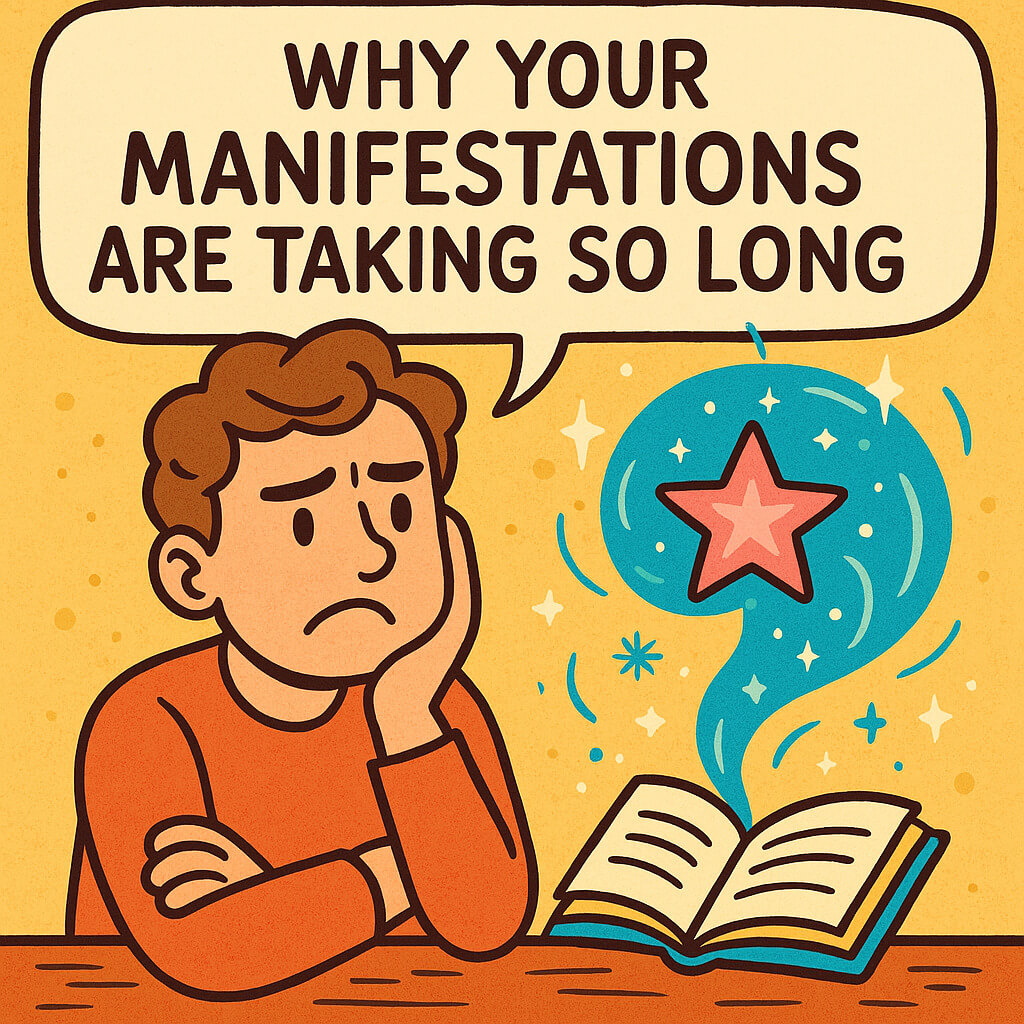
You’ve been visualizing your goals. Repeating affirmations. Trying to feel grateful. Maybe you’ve created a vision board, listened to manifestation audios, journaled about your future, and imagined the life you want.
But your manifestation still hasn’t arrived.
And eventually, the question appears:
Why is my manifestation taking so long?
You may start wondering whether you are doing something wrong. Maybe your belief begins to weaken. Maybe you start checking for signs every day, looking for proof that something is finally changing.
According to many manifestation teachings, this is often where people accidentally create more resistance.
Manifestation is not simply about wanting something intensely. It is also about your mindset, expectations, beliefs, emotional patterns, and the actions you take while pursuing what you want.
If your manifestations seem to be taking longer than expected, it does not necessarily mean you have failed. It may mean that there is a disconnect between what you consciously desire and the patterns you repeatedly reinforce.
The good news is that these patterns can be examined and changed.
Here are seven common reasons your manifestations may feel delayed—and what you can do about each one.
1. You’re Focused on Wanting Rather Than Aligning
There is a major difference between wanting something and feeling internally aligned with the possibility of having it.
You can say, “I want more money,” while spending most of the day thinking:
I never have enough.
You can say that you want success while repeatedly telling yourself:
People like me never get ahead.
Or you may want a better relationship while constantly focusing on loneliness and disappointment.
According to manifestation teachings, the dominant story you repeatedly tell yourself matters more than the occasional affirmation you say in the morning.
Many practitioners describe manifestation as a process of alignment. In this framework, you begin shifting your thoughts, expectations, emotions, and behavior toward the reality you want to experience.
This does not mean pretending that problems do not exist. It means becoming more aware of the mental and emotional habits that continually pull your attention back toward lack.

How to shift into greater alignment
Start by noticing where your attention goes automatically.
If your goal is financial abundance, do you spend most of your time mentally rehearsing financial problems? If your goal is success, do you constantly imagine failure?
You can begin changing the pattern by asking:
What would I focus on if I genuinely believed improvement was possible?
Then practice thoughts that support that possibility.
You might focus on opportunities, skills you can develop, resources already available to you, or examples of progress you have made.
Gratitude can also be useful here. It does not mean forcing yourself to feel positive about everything. Instead, it helps redirect attention toward what is already working while remaining open to creating something better.
The goal is not perfection. The goal is to spend less time rehearsing the reality you want to leave behind.
2. You’re Obsessing Over Exactly How It Will Happen
One of the easiest ways to turn a desire into a source of stress is to become obsessed with controlling every step of the process.
You want more money, so you decide it must arrive through one specific job.
You want success, so you become convinced it can only happen through one opportunity.
You want a relationship, so you become attached to one particular person or outcome.
Then, when life does not follow the exact script you created, frustration takes over.
Many manifestation teachings encourage people to become clear about what they want without becoming excessively attached to controlling how it arrives.
This does not mean abandoning planning or refusing to make practical decisions. Planning is valuable. Taking action is valuable.
The problem begins when you confuse your current plan with the only possible path.
Sometimes the opportunity you need does not look like the opportunity you expected.
A new conversation may lead to a useful connection. A skill you decide to learn may open a door months later. A disappointing experience may push you toward a better direction.
You do not have to know every step before taking the next one.

How to let go of the “how”
Be specific about the outcome you want, but remain flexible about the route.
Ask yourself:
What is my goal—and what are several possible ways I could move closer to it?
This simple shift can reduce mental rigidity and help you notice opportunities that you might otherwise ignore.
Visualization can also help when it focuses on the experience of achieving a goal rather than trying to control every detail of how the goal must appear.
See yourself enjoying the result. Imagine how you would think, act, and feel.
Then return to the present and ask:
What is one useful action I can take today?
How to Fix It:
- Let go of the “how” and trust that the universe has infinite ways to bring you what you want.
- Focus on the feeling of already having it, rather than trying to force specific outcomes.
- Stay open to unexpected opportunities and synchronicities. The universe often delivers in ways you never expect.
3. Your Words and Your Beliefs Are Sending Different Messages
You can repeat an affirmation a hundred times and still struggle to believe it.
That is one reason affirmations sometimes feel ineffective.
If you say, “I am successful,” but immediately think, That is obviously not true, your internal dialogue is working against the statement.
The issue is not that you failed to repeat the affirmation enough times. The issue may be that the new thought is too far away from what you currently believe.
This is where limiting beliefs become important.
A limiting belief is simply an assumption you repeatedly treat as true, even when it may not be universally true.
For example:
- “Making money is always difficult.”
- “Successful people are different from me.”
- “I always fail.”
- “I’m not worthy of having what I want.”
- “Opportunities never come my way.”
These beliefs can influence what you notice, what you expect, and whether you take action when opportunities appear.

How to change the pattern
Start by identifying the belief beneath the problem.
Instead of asking only, Why am I not manifesting more money?, ask:
What do I genuinely believe about money?
Write down your first honest answers.
Then begin replacing extreme, limiting beliefs with thoughts that feel more believable and empowering.
For example:
Instead of:
“Money always comes easily to me.”
You might begin with:
“I am becoming more open to new ways of creating income.”
Or:
“I am learning to recognize opportunities that can improve my financial situation.”
As your mindset develops, your affirmations can become stronger and more expansive.
The important thing is consistency. One positive statement followed by an entire day of negative self-talk is unlikely to create a meaningful mental shift.
Pay attention to the story you repeat most often.
That is the story you are practicing.
4. Doubt and Fear Are Controlling Your Decisions
Doubt is normal.
Fear is normal.
The goal is not to become a person who never experiences either one.
The problem is allowing doubt and fear to make every important decision for you.
Imagine someone who wants to start a business but constantly thinks:
What if nobody buys?
They may never launch.
Someone else may want a promotion but believe:
I’m probably not qualified.
So they never apply.
Someone may want to change their life but keep waiting until they feel completely confident.
That moment may never come.
According to manifestation and personal-development teachings, belief often grows through experience. You do not always have to eliminate doubt before moving forward.
Sometimes you take action while doubt is still present.

How to build stronger belief
Look for evidence from your own life.
What challenges have you handled before?
What goals have you achieved that once seemed difficult?
What skills have you developed over time?
Small evidence matters because it reminds you that your current circumstances are not necessarily permanent.
You can also use visualization and affirmations to practice a new mental direction. But combine inner work with real-world movement.
Confidence often grows when you repeatedly show yourself that you can take action despite uncertainty.
You do not need perfect belief.
You need enough belief to take the next step.
5. You’re Waiting for a Miracle Instead of Taking Inspired Action
Manifestation is sometimes misunderstood as passive wishing.
You visualize.
You affirm.
You wait.
And then you wonder why nothing changes.
But personal transformation usually requires participation.
Many manifestation teachers use the term inspired action to describe action that feels connected to your goals, values, intuition, or sense of direction.
Inspired action does not mean waiting for a dramatic sign from the universe before doing anything.
Sometimes inspired action is surprisingly ordinary.
It may mean sending the email you have been avoiding.
Applying for the opportunity.
Learning a new skill.
Starting the project.
Having an uncomfortable conversation.
Creating something before you feel completely ready.
The key is to avoid using manifestation as an excuse to remain passive.
If you are manifesting financial success, ask yourself what practical actions support that vision.
Could you improve a skill?
Explore a new source of income?
Create something useful?
Reach out to someone?
Learn more about managing your money?
Your inner world and your outer actions do not have to compete.
They can support each other.

A simple practice
At the beginning of each day, ask:
What is one action I can take today that moves me closer to the life I want?
It does not need to be dramatic.
Small actions, repeated consistently, can create momentum.
And momentum often changes what you believe is possible.
6. You’re Constantly Checking Whether It Has Happened Yet
This is one of the most common manifestation traps.
You set an intention.
Then you check.
And check again.
Is it working yet?
Where is it?
Why hasn’t anything happened?
Maybe I did it wrong.
This constant monitoring can turn your desire into a daily reminder of its absence.
In manifestation teachings, this is often described as attachment or resistance. From a practical mindset perspective, it can also consume attention and create unnecessary stress.
Imagine planting a seed and digging it up every morning to see whether it has grown.
At some point, you have to plant, nurture, and allow time for development.
That does not mean becoming passive. It means releasing the need to measure your progress every hour.

How to practice detachment
Detachment does not mean you stop caring about your goal.
It means your emotional well-being is no longer entirely dependent on getting the result immediately.
Continue working toward what you want.
Continue noticing opportunities.
But also continue living your life.
Enjoy the present. Develop your skills. Spend time with people you care about. Explore new experiences.
The more your entire identity revolves around waiting for one outcome, the easier it becomes to feel that you are missing something.
Instead of asking every day, When will it happen?, try asking:
Who am I becoming while I work toward it?
That question puts some of your attention back where you have influence.
7. Your Environment Keeps Reinforcing the Old Version of You
Your environment matters.
If your physical space is chaotic, your schedule is constantly draining, and every conversation reinforces negativity, it can become difficult to maintain the mindset you are trying to build.
You may spend ten minutes visualizing a better future and then spend the rest of the day surrounded by messages telling you why nothing will ever change.
That creates friction.
Your environment does not have to be perfect, and you do not need to remove every negative influence from your life.
But you can become more intentional.

Create an environment that supports your goals
Start with your physical space.
A cleaner, more organized environment can make it easier to focus and follow through on the habits you want to build.
Then look at the information you consume.
Are you constantly filling your mind with content that increases fear, comparison, or hopelessness?
Or are you regularly exposed to ideas that encourage growth, possibility, learning, and constructive action?
Finally, pay attention to the people around you.
You do not need everyone to agree with your goals. But spending time with supportive people can make it easier to stay committed when motivation drops.
You can also create a personal manifestation space.
It does not need to be elaborate.
A chair, a journal, a vision board, or a quiet corner can become a place where you reflect on your goals, visualize your desired future, write affirmations, meditate, or simply reconnect with your intentions.
The purpose is not the object itself.
The purpose is creating a consistent practice that reminds you of the direction you have chosen.
The Hidden Reason Your Manifestation May Feel Delayed
Sometimes the biggest problem is not a lack of technique.
It is inconsistency.
You visualize for three days.
Then you spend the next week telling yourself that nothing ever works.
You repeat affirmations in the morning.
Then criticize yourself for the rest of the day.
You set an ambitious goal.
Then avoid taking the actions required to move toward it.
Manifestation practices are often most useful when they become part of a broader process of personal development.
Your thoughts influence your expectations.
Your expectations influence your decisions.
Your decisions influence your actions.
And your repeated actions help shape your results.
From a manifestation perspective, many practitioners would also describe this as becoming energetically aligned with the reality you want to experience.
You do not have to choose between the spiritual and practical perspectives.
Use the practices that help you become more focused, intentional, confident, and willing to act.
A Simple Reset When Your Manifestations Feel Stuck
If you feel like nothing is happening, try this reset:
1. Get clear about what you actually want
Write your desire in simple, specific language.
2. Identify the story that contradicts it
Ask yourself what you currently believe about your ability to achieve it.
3. Practice a more empowering perspective
Choose affirmations, visualization, journaling, or reflection practices that help reinforce the direction you want to move.
4. Take one practical action
Do something that supports your goal, even if the step is small.
5. Stop monitoring every moment
Give yourself permission to continue living while the process unfolds.
6. Repeat
Real change is usually built through repetition.
Final Thoughts
If your manifestations are taking longer than you expected, do not automatically assume that nothing is working.
Take a closer look at what you are consistently practicing.
Are you focusing on what you want—or constantly rehearsing what you fear?
Are your beliefs supporting your goals—or quietly contradicting them?
Are you waiting for the perfect moment—or taking meaningful action?
Are you so attached to the outcome that you have forgotten to live in the present?
According to manifestation teachings, alignment begins when your intentions, beliefs, emotions, and actions begin moving in the same direction.
That does not mean you will control every outcome or receive everything on your preferred timeline.
But you can control the habits you practice, the story you reinforce, the actions you take, and the person you are becoming.
Shift your focus. Strengthen your mindset. Take inspired action. Release the need to control every step.
Then keep moving.
Sometimes the most important question is not:
“Why is my manifestation taking so long?”
It is:
“What can I change today that helps me become more aligned with the life I want to create?”