Meditation has become one of the most popular tools for relaxation, personal growth, manifestation, and spiritual development. Yet one important question is often overlooked:
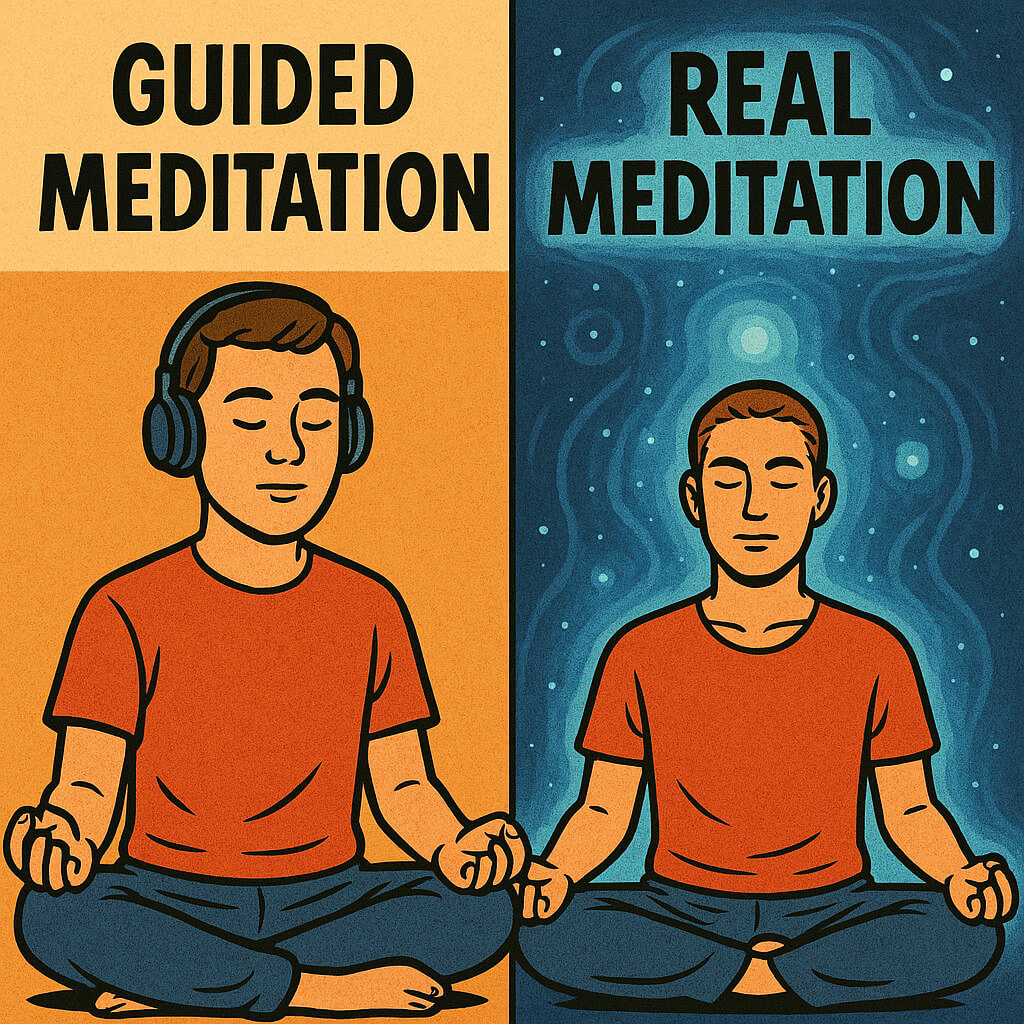
Is guided meditation the same thing as real meditation?
Not necessarily.
You can put on headphones, close your eyes, and follow a soothing voice as it guides you through a peaceful forest, a visualization of your dream life, or a manifestation exercise. You may feel calmer, more focused, and emotionally uplifted.
And there is nothing inherently wrong with that.
However, guided meditation and silent meditation can serve different purposes. One actively directs the mind. The other can involve stepping back from mental activity and learning to rest in stillness and awareness.
Understanding that difference can completely change the way you approach your practice.
If you use meditation for manifestation, mindset transformation, spiritual growth, or simply gaining greater control over your inner world, knowing when to visualize and when to become still can be incredibly valuable.
Let’s break it down.
What Is Guided Meditation?
Guided meditation is exactly what it sounds like: your experience is guided by an external voice, recording, or set of instructions.
The guide may encourage you to:
- Focus on your breathing
- Relax different parts of your body
- Imagine a peaceful place
- Visualize a specific goal
- Repeat affirmations
- Imagine your desired future
- Release negative emotions
- Focus on feelings such as gratitude, abundance, or confidence
For many people, guided meditation is an accessible starting point because it gives the mind something constructive to focus on.
Instead of allowing your attention to jump from one worry to another, you are deliberately directing it.
That can be especially useful if you are interested in manifestation techniques.
For example, you might visualize yourself achieving a financial goal, living in your dream home, succeeding in your career, or experiencing a greater sense of freedom.
According to many manifestation teachings, repeatedly focusing your attention on a desired outcome can help you develop beliefs, expectations, emotions, and behaviors that are more aligned with that vision.
In practical terms, visualization may also help you become clearer about what you want. A vague desire such as “I want more money” can become more specific when you spend time imagining what financial freedom actually looks like to you.
What Guided Meditation Can Be Useful For
Guided meditation can be valuable for:
- Relaxation and stress management
- Developing focus
- Visualization exercises
- Building a manifestation routine
- Practicing gratitude
- Strengthening positive intentions
- Preparing for sleep
- Exploring emotional patterns
- Creating a regular meditation habit
However, guided meditation usually keeps the mind engaged with an activity.
You may be imagining.
You may be listening.
You may be repeating words.
You may be following instructions.
That is why it is useful to recognize that guided meditation and silent meditation are not necessarily the same experience.

Guided Meditation vs. Visualization: Are They the Same?
Visualization is often included inside guided meditation, but the two are not identical.
A guided meditation may contain visualization, breathing, relaxation, affirmations, or other mental exercises.
Visualization itself is the deliberate practice of creating mental images.
For manifestation, a visualization exercise might involve imagining:
- Receiving a promotion
- Building a successful business
- Reaching a financial goal
- Living with greater freedom
- Completing an important personal goal
The key point is that visualization gives the mind something to do.
You are intentionally creating or holding an internal experience.
This can be useful.
But it is different from sitting quietly and allowing mental activity to settle without deliberately replacing one thought with another.
That distinction becomes important when we look at what many people describe as real meditation.
What Is Real Meditation?
The term real meditation can mean different things depending on the tradition.
Some meditation practices involve concentration. Others involve observing thoughts. Others use mantras, movement, breathing, prayer, or visualization.
However, when people contrast guided meditation with what they call real meditation, they are usually referring to a practice of greater silence and direct awareness.
There is no voice telling you where to go.
There is no story to follow.
There is no future scene to create.
You sit.
You become aware.
And rather than trying to control every thought, you gradually learn to observe mental activity without automatically following it.
This does not necessarily mean that you must achieve a completely blank mind.
For most people, thoughts will continue to arise.
The practice is not always about forcefully eliminating them.
It is about changing your relationship with them.
A thought appears.
You notice it.
And instead of immediately chasing it, analyzing it, or building an entire emotional story around it, you allow your attention to return to the present moment.
For many practitioners, this is where meditation becomes much deeper.
You begin to realize something important:
You are not required to react to every thought that enters your mind.
That realization can have enormous value for personal development, manifestation, and success.
Why Silence Can Be So Powerful
Your daily life is filled with mental input.
Messages.
Notifications.
News.
Conversations.
Problems.
Plans.
Goals.
Worries.
Even many self-improvement practices ask you to think more: analyze your beliefs, repeat affirmations, visualize your future, plan your next move, and solve another problem.
Silent meditation creates a different kind of space.
For a few minutes, you stop trying to mentally construct your entire life.
You simply become present.
Many spiritual traditions associate this kind of stillness with deeper awareness, intuition, and connection to something beyond ordinary thinking.
From a manifestation perspective, many practitioners believe that stillness can help you become more aware of the beliefs, fears, and mental patterns that may be influencing your actions.
When the constant internal noise becomes quieter, you may notice what has been operating in the background.
Perhaps you constantly expect failure.
Perhaps you mentally rehearse financial problems.
Perhaps you say you want abundance while repeatedly imagining everything going wrong.
You cannot easily change a pattern that you never notice.
Stillness gives you an opportunity to notice.
And awareness is often the first step toward transformation.

Guided Meditation Keeps You Focused. Silent Meditation Helps You Observe.
Here is a simple way to understand the difference.
Guided Meditation
Guided meditation generally asks you to direct your attention somewhere.
You may focus on:
- A voice
- Your breathing
- A visualization
- An affirmation
- A desired outcome
- A feeling or emotion
Silent Meditation
Silent meditation often asks you to become aware of what is already happening.
You may notice:
- Thoughts
- Emotions
- Physical sensations
- Your breathing
- Silence
- The space between thoughts
Neither approach is automatically better in every situation.
They simply have different strengths.
If your goal is to rehearse a desired future, guided visualization may be useful.
If your goal is to develop greater awareness of your mind, silent meditation may be more appropriate.
The most powerful approach for many people may not be choosing one forever.
It may be learning how to use both intentionally.
The Manifestation Mistake Many People Make
One common mistake is treating visualization as a substitute for inner awareness.
You can spend 20 minutes imagining wealth, success, or your dream life.
Then you open your eyes and immediately return to the same patterns:
“I never have enough.”
“People like me don’t become successful.”
“Money always disappears.”
“This probably won’t work.”
The visualization and the dominant mental pattern are moving in opposite directions.
That is why meditation can become a valuable companion to manifestation.
Visualization can help you define the direction you want to move toward.
Stillness can help you become more aware of the inner patterns that may be pulling you in another direction.
In other words:
Visualization can help you create the picture. Awareness can help you notice what is interfering with it.
This is one reason meditation for manifestation can be such a powerful practice.
You are not simply trying to imagine a better future.
You are also learning to become less controlled by the automatic mental habits of the past.
How to Transition From Guided Meditation to Silent Meditation
If you have relied on guided meditations for years, sitting in silence may initially feel strange.
Your mind may immediately begin producing thoughts.
That is normal.
The goal is not to win a battle against your mind.
Try this simple approach.
1. Start Small
Begin with five to ten minutes.
You do not need an hour-long spiritual practice to begin developing greater stillness.
Sit comfortably somewhere you are unlikely to be interrupted.
2. Remove the Constant Input
No guided voice.
No podcast.
No instructions telling you what to imagine.
If complete silence feels uncomfortable, you can gradually reduce external guidance rather than forcing yourself to make an immediate change.
3. Allow Thoughts to Appear
This is important.
Do not panic because you are thinking.
The moment you notice that your attention has drifted, simply return to awareness.
You might use your natural breathing as a gentle anchor.
4. Notice the Space Between Thoughts
Even a busy mind is not thinking one uninterrupted thought forever.
There are pauses.
Moments of quiet.
Brief spaces.
Rather than trying to manufacture silence, begin noticing the silence that already exists between mental activity.
5. Practice Consistently
Five or ten minutes practiced consistently can be more valuable than one extremely long session that you never repeat.
The goal is to develop familiarity with stillness.
Over time, many people find that they become better at recognizing when they are caught in unnecessary mental noise.
Can You Combine Visualization and Silent Meditation?
Absolutely.
In fact, combining the two can create a balanced practice.
You might begin with five minutes of quiet meditation.
Allow yourself to become present.
Observe your thoughts without chasing them.
Then spend five minutes visualizing a specific goal.
For example, if you are working toward greater financial success, you could first become aware of your current mental state.
Then visualize yourself behaving, thinking, and making decisions as the person you want to become.
Finally, end with another few minutes of silence.
This approach creates a useful balance between intention and awareness.
You are not constantly trying to force an outcome.
But you are also not avoiding direction or action.
You become clear about what you want, aware of what is happening internally, and more capable of making practical decisions that support your goals.
What About Brainwaves, Energy, and Higher Consciousness?
Meditation is often associated with concepts such as alpha, theta, and other brainwave patterns.
These terms describe patterns of electrical activity in the brain, and different states of consciousness, relaxation, and sleep are associated with different types of brain activity.
However, meditation is not a simple switch where every person reaches the same brainwave state at the same moment.
The spiritual interpretation goes further.
Many practitioners believe that deep meditation can help a person access higher states of consciousness, greater intuition, and a deeper connection with universal energy.
In some spiritual traditions, meditation is also associated with the pineal gland and the idea of the third eye.
These ideas are meaningful within spiritual and metaphysical frameworks, although they should not be confused with established scientific proof that meditation activates supernatural abilities.
What matters for your personal practice is the experience itself.
Does meditation help you become calmer?
More aware?
More focused?
More intentional?
More connected to your values and goals?
Does it help you recognize the mental patterns that keep repeating in your life?
Those questions may ultimately be more useful than obsessing over whether you have reached a particular frequency.

A Practical Meditation Routine for Manifestation and Personal Growth
Here is a simple 15-minute practice you can experiment with.
Minutes 1–5: Become Still
Sit quietly.
Notice your breathing.
Allow thoughts to come and go without trying to fight them.
Minutes 6–10: Visualize Your Desired Direction
Choose one clear area of your life.
It could be:
- Wealth
- Career success
- Confidence
- Relationships
- Health
- Personal freedom
Visualize yourself moving toward that outcome.
Focus not only on what you have, but on how you think, act, and make decisions.
Minutes 11–15: Return to Silence
Let go of the visualization.
Stop trying to create anything mentally.
Simply sit with the experience.
This final period of silence can prevent visualization from becoming another exhausting mental task.
You have set an intention.
Now you allow yourself to become still again.
The Real Question: What Do You Want From Meditation?
Guided meditation is not useless.
Visualization is not useless.
Silent meditation is not the only valid form of meditation.
The real question is:
What are you trying to accomplish?
If you need help relaxing, guided meditation may be a great tool.
If you want to practice visualization for manifestation, a guided exercise may help you create focus.
If you want to become less reactive to your thoughts and develop greater self-awareness, a quieter practice may be worth exploring.
And if you are seeking spiritual growth, many practitioners believe that learning to sit in stillness can open an entirely different relationship with yourself and your inner world.
The mistake is not using guided meditation.
The mistake is assuming that every practice produces the same experience.
They do not.
Guided Meditation vs. Real Meditation: The Bottom Line
Guided meditation can help direct the mind.
Visualization can help you clarify a desired future.
Silent meditation can help you observe the mind without constantly feeding it more instructions.
Each has a place.
But if you have spent years listening to other people tell you what to imagine, what to feel, and where to direct your attention, consider giving yourself another experience.
Sit in silence.
Put away the headphones.
Stop trying to visualize the perfect future for a few minutes.
And simply observe.
According to many spiritual and manifestation teachings, profound transformation does not always begin when you add another thought to your mind.
Sometimes, it begins when you finally create enough silence to hear what has been there all along.
The choice is yours.
You can use guided meditation when you want direction.
You can use visualization when you want to strengthen intention.
And you can practice stillness when you want to step back from the endless stream of mental activity.
The deeper your awareness becomes, the more consciously you can choose your thoughts, your actions, and ultimately, the direction of your life.