The first moments of your morning can shape far more than your schedule.
They can shape your state of mind.
Before the emails, notifications, responsibilities, opinions, and distractions begin competing for your attention, there is a brief window when you have an opportunity to choose how you want to feel, think, and move through the day.
And according to manifestation teachings, that matters.
Many people want to manifest more money, opportunities, happiness, confidence, or success, yet they begin every morning by reconnecting with the exact energy they are trying to leave behind.
They wake up and immediately check their phone.
They think about bills.
They replay yesterday’s problems.
They scroll through other people’s lives.
They rush.
And before the day has truly begun, their attention has already been given away.
But what if you approached your morning differently?
What if, instead of allowing the outside world to determine your emotional state, you deliberately created an inner environment that supported the life you want to build?
That is the purpose of a manifestation-focused morning routine.
You do not need a complicated two-hour ritual. You do not need to perform every spiritual practice perfectly. And you certainly do not need to feel guilty if your mornings are busy.
The real goal is much simpler:
Start the day intentionally.
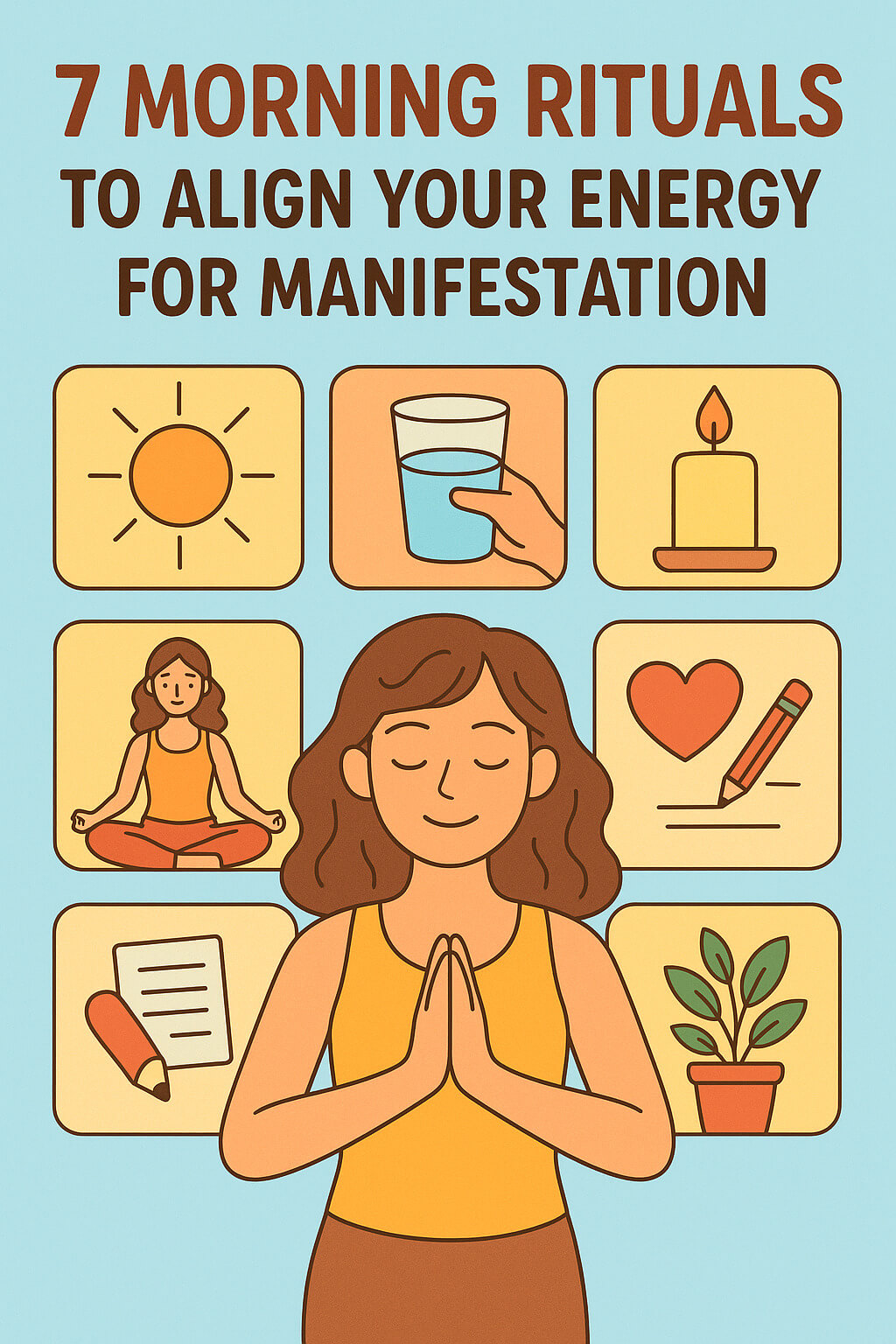
Below are seven morning rituals that can help you align your thoughts, emotions, focus, and energy with the direction you want your life to move.

1. Wake Up in Gratitude
Your first thoughts can become the starting point for everything that follows.
If you wake up immediately thinking, I have too much to do, Nothing is working, or Here we go again, you begin reinforcing a familiar emotional pattern before your feet even touch the floor.
Gratitude gives you another option.
Before reaching for your phone, pause for a moment.
Take a slow breath.
Then think of three things you genuinely appreciate.
They do not have to be extraordinary.
You might appreciate:
- A new day and another opportunity to begin again.
- A person who supports you.
- A comfortable bed.
- Your health or physical abilities.
- An opportunity you have been given.
- Something exciting you are working toward.
The important part is not simply making a mental list.
Try to feel the appreciation.
In manifestation and spiritual traditions, gratitude is often associated with abundance because it shifts your attention away from what appears to be missing and toward what is already present.
And from a practical mindset perspective, that shift can change how you approach the rest of your day.
Instead of beginning from a feeling of lack, you begin from a place of appreciation.
You start noticing possibilities instead of immediately searching for problems.
You become more conscious of what is already working.
A simple practice is to keep a journal beside your bed and write down three things you are grateful for each morning.
You can also explore how gratitude can support your manifestation practice in more depth.
The ritual takes only a few minutes, but it can create a powerful question for the rest of your day:
What else is already good in my life that I have been too distracted to notice?
2. Hydrate With Intention
After several hours of sleep, drinking water can be a simple way to begin caring for your body.
But you can also turn this ordinary habit into a moment of intention.
Instead of rushing through your morning on autopilot, pause while drinking your first glass of water.
Take a breath.
Ask yourself how you want to feel today.
Clear?
Focused?
Energized?
Peaceful?
Confident?
Then connect that intention to the action.
You might silently say:
“Today, I choose clarity and positive energy.”
Or:
“I am ready to take care of my body, my mind, and my goals.”
The power of this ritual does not have to come from believing that water itself will magically create a new reality.
The value can come from something much more practical: you are practicing conscious attention.
You are reminding yourself that the day has begun and that you have a choice in how you show up for it.
Many spiritual and manifestation practices use symbols, rituals, visualization, and intention to create a stronger connection between an inner decision and an outward action. Your morning glass of water can become one of those small anchors.
If adding lemon to your water is something you enjoy, you can certainly do that too. Or simply drink a glass of water while visualizing yourself becoming more awake, clear, and ready for the opportunities ahead.
The point is simple:
Do not just rush into your day. Arrive in it.
3. Move Your Body and Shift Your State
Sometimes the fastest way to change how you feel is to change what you are doing physically.
You do not need an intense workout.
You do not need expensive equipment.
And you do not need to turn your morning into a fitness competition.
Even a few minutes of intentional movement can help you feel more awake and engaged.
Stretch.
Walk outside.
Do some gentle yoga.
Put on an uplifting song and dance.
Do a few minutes of mobility exercises.
The specific activity matters less than the experience.
Ask yourself:
What kind of movement makes me feel more alive?
For one person, that may be a peaceful walk in nature.
For another, it may be energetic music and dancing around the room.
For someone else, it may be ten minutes of stretching while taking slow, deep breaths.
From a manifestation perspective, movement can also serve as a symbolic reminder that energy is not meant to remain stuck in yesterday’s story.
You may have experienced frustration yesterday.
You may have made a mistake.
You may be waiting for a result that has not arrived yet.
But today is a new opportunity to take another step.
As you move, experiment with an affirmation or intention such as:
- “I am moving forward.”
- “I am open to new opportunities.”
- “I have the energy to take meaningful action.”
- “I release yesterday and focus on what I can create today.”
This is not about forcing yourself to feel perfect.
It is about changing your state before you become trapped in the same mental patterns.
4. Speak Your Intentions and Use Affirmations
Words influence the way you frame your experiences.
And the words you repeatedly say to yourself can gradually become part of your internal story.
That is why affirmations can be useful when they are approached with intention rather than treated as magic phrases that automatically guarantee results.
Before checking your messages or listening to everyone else’s opinions, spend a few moments deciding what you want to reinforce in your own mind.
You might say:
- “Today, I will look for opportunities.”
- “I trust myself to handle what comes my way.”
- “I am becoming more confident and capable every day.”
- “I am open to abundance and willing to take action when opportunities appear.”
- “Today, I choose to focus on what I can influence.”
If the affirmation feels completely unbelievable, adjust it.
For example, instead of forcing yourself to say, “I am a millionaire,” when that thought creates resistance, you might say:
“I am learning to think differently about money and recognize new opportunities for growth.”
The best affirmations are often the ones you can connect with emotionally.
They give your mind a direction.
For a deeper guide, see how to use affirmations the right way.
The key is consistency.
You are not trying to convince the universe with the loudest possible declaration.
You are training yourself to become more conscious of the beliefs, assumptions, and internal language that influence your decisions.
5. Visualize and Feel Your Ideal Future
Visualization is one of the most popular practices in manifestation.
The basic idea is simple: spend time imagining the life, goal, or experience you want to create, then connect with the emotions associated with that possibility.
But there is an important difference between visualization and vague daydreaming.
Effective visualization is intentional.
Instead of simply imagining a mansion, a luxury car, or a huge bank account for a few seconds, try imagining yourself living as the person capable of creating and managing the life you desire.
What would you do differently?
How would you carry yourself?
What decisions would you make?
How would you respond to challenges?
If your goal is greater financial success, imagine yourself feeling calm and capable around money.
If your goal is a successful business, visualize yourself completing meaningful work, communicating confidently, and recognizing opportunities.
If your goal is a happier life, imagine the ordinary moments you would experience: waking up peacefully, enjoying your work, spending time with people you value, and feeling more present.
This approach makes visualization more than wishful thinking.
It becomes a way to mentally rehearse a new identity and direction.
Close your eyes for a few minutes and picture a scene that represents your desired future.
Then ask:
What emotion does this version of my life represent?
Freedom?
Confidence?
Security?
Joy?
Gratitude?
Connection?
Allow yourself to experience that feeling now, even if only briefly.
According to manifestation teachings, feeling emotionally connected to a desired reality can help you align your inner state with what you want to experience. From a practical perspective, visualization can also help clarify what you actually want and keep your attention focused on meaningful goals.
You can learn more about the power of visualization.
And if you enjoy guided approaches, visualization and audio-based tools can also be incorporated naturally into a broader manifestation practice.
6. Listen to Inspirational Audio or Read Self-Improvement Content
What enters your mind in the morning can influence what occupies your attention for the rest of the day.
That is why your first input matters.
You can begin the morning with negative headlines, arguments, complaints, and social media comparison.
Or you can deliberately choose something that expands your thinking.
Listen to an inspiring talk.
Play a motivational audio.
Listen to a personal-development podcast.
Read a few pages of a book about success, mindset, wealth, discipline, spirituality, or personal growth.
You do not need to spend an hour doing this.
Even ten minutes of intentional learning can become a valuable part of your morning.
Many people find the transition between sleep and full wakefulness to be a particularly quiet and reflective time. Rather than focusing too heavily on a specific brainwave label or claiming that your mind can simply be “programmed,” use this period as an opportunity to choose your mental input more consciously.
Ask yourself:
What ideas do I want to carry into today?
Perhaps you listen to something that reminds you to take responsibility for your goals.
Perhaps you read about building wealth.
Perhaps you explore a new spiritual perspective.
Perhaps you simply listen to someone whose message encourages you to think bigger.
The goal is not to consume endless motivational content.
The goal is to find one useful idea and apply it.
After listening or reading, write down one sentence:
Today, I will use this idea by __________.
That final step is important.
Information can inspire you.
But action is what turns inspiration into change.
For more inspiration and personal-development content, you can also explore The Kevin Trudeau Show: Limitless.
7. Meditate and Breathe for 15–20 Minutes
If your morning is usually filled with noise, meditation can become the ritual that gives you space.
You do not need to eliminate every thought.
You do not need to have a mystical experience.
And you do not need to become an expert at sitting still.
Simply begin.
Find a comfortable, quiet place.
Set a timer for 15 to 20 minutes if your schedule allows.
Close your eyes.
Bring your attention to your breathing.
Notice the sensation of inhaling.
Notice the sensation of exhaling.
When thoughts appear—and they will—do not fight them.
Notice them.
Then gently return your attention to your breath.
Over time, meditation can become a practice of observing your thoughts rather than automatically following every one of them.
From a manifestation perspective, many practitioners use meditation to quiet mental noise, become more receptive to intuition, and reconnect with the feelings and intentions they want to cultivate.
You can also use the final few minutes of your meditation to ask a simple question:
What is the most important thing for me to focus on today?
Do not force an answer.
Just create the space.
For some people, meditation is also a natural time to transition into visualization, affirmations, or guided audio.
If you are interested in developing this practice further, explore meditation for manifestation.
Stillness can be powerful precisely because so much of modern life encourages the opposite.
When you learn to pause before reacting, you may begin making choices from greater awareness rather than habit.
The Most Important Rule: Do Not Try to Do Everything
Here is where many morning routines fail.
Someone reads about seven powerful rituals and immediately thinks:
“Great. Now I need to wake up two hours earlier and do all seven.”
No.
That is not the point.
A morning routine should support your life, not become another source of pressure.
You may love meditation but dislike journaling.
You may enjoy walking but have no interest in affirmations.
You may have twenty minutes available on some mornings and only five on others.
That is perfectly fine.
Choose the rituals that genuinely align with your schedule, personality, lifestyle, and current goals.
You might begin with:
A 5-Minute Morning
- Think of three things you appreciate.
- Drink a glass of water.
- Set one clear intention for the day.
A 15-Minute Morning
- Spend five minutes moving.
- Spend five minutes visualizing or meditating.
- Spend five minutes listening to something inspiring.
A 30-Minute Morning
- Gratitude.
- Movement.
- Meditation.
- Visualization.
- Personal-development reading or audio.
There is no universal “perfect” routine.
The best morning ritual is the one you will actually practice.
Consistency beats complexity.
Start with one or two rituals.
Practice them long enough to understand how they affect your mindset.
Then add more only if they genuinely improve your life.
Your Morning Is a Starting Point, Not a Test
Manifestation is often discussed in terms of vibration, energy, belief, focus, and emotional alignment.
But none of these ideas require you to become perfect.
You will still have difficult mornings.
You will still experience stress.
You will still have days when meditation feels impossible and gratitude does not come easily.
That does not mean you have failed.
A morning ritual is not a test you either pass or fail.
It is a practice.
It is a decision to return your attention to what you want to create instead of automatically repeating everything you experienced yesterday.
You can begin with gratitude.
Move your body.
Speak a more empowering intention.
Visualize the person you are becoming.
Feed your mind with useful ideas.
Sit in stillness.
Or simply take one conscious breath before the demands of the day begin.
Choose what resonates with you.
Make it practical.
Make it personal.
And most importantly, make it consistent.
Your morning does not have to be perfect to be powerful.
Sometimes, the smallest intentional action is enough to remind you of something important:
You may not control everything that happens today—but you can choose the energy, mindset, and attention you bring to it.
And according to manifestation teachings, that inner shift can be the beginning of an entirely different reality.
In Summary
Your morning sets the tone for your entire life.
When you consciously align your energy each morning — through gratitude, hydration, movement, meditation, learning, visualization, and emotional intention — you step into your true creative power.
You are not waiting for the universe to bring you what you want.
You are broadcasting your desires with clarity and confidence, and the universe has no choice but to respond.