What if your emotions are giving you useful information all day long—but you have never learned how to interpret the message?
Think about it.
You wake up feeling discouraged, spend the morning thinking about everything that could go wrong, become frustrated by something small, and then wonder why the rest of the day seems to follow the same pattern.
Now imagine approaching your emotions differently.
Instead of treating an uncomfortable emotion as something you need to suppress, ignore, or fight, you begin seeing it as a signal. You become aware of where you are emotionally, recognize the direction you want to move, and deliberately choose thoughts and actions that help you feel a little better.
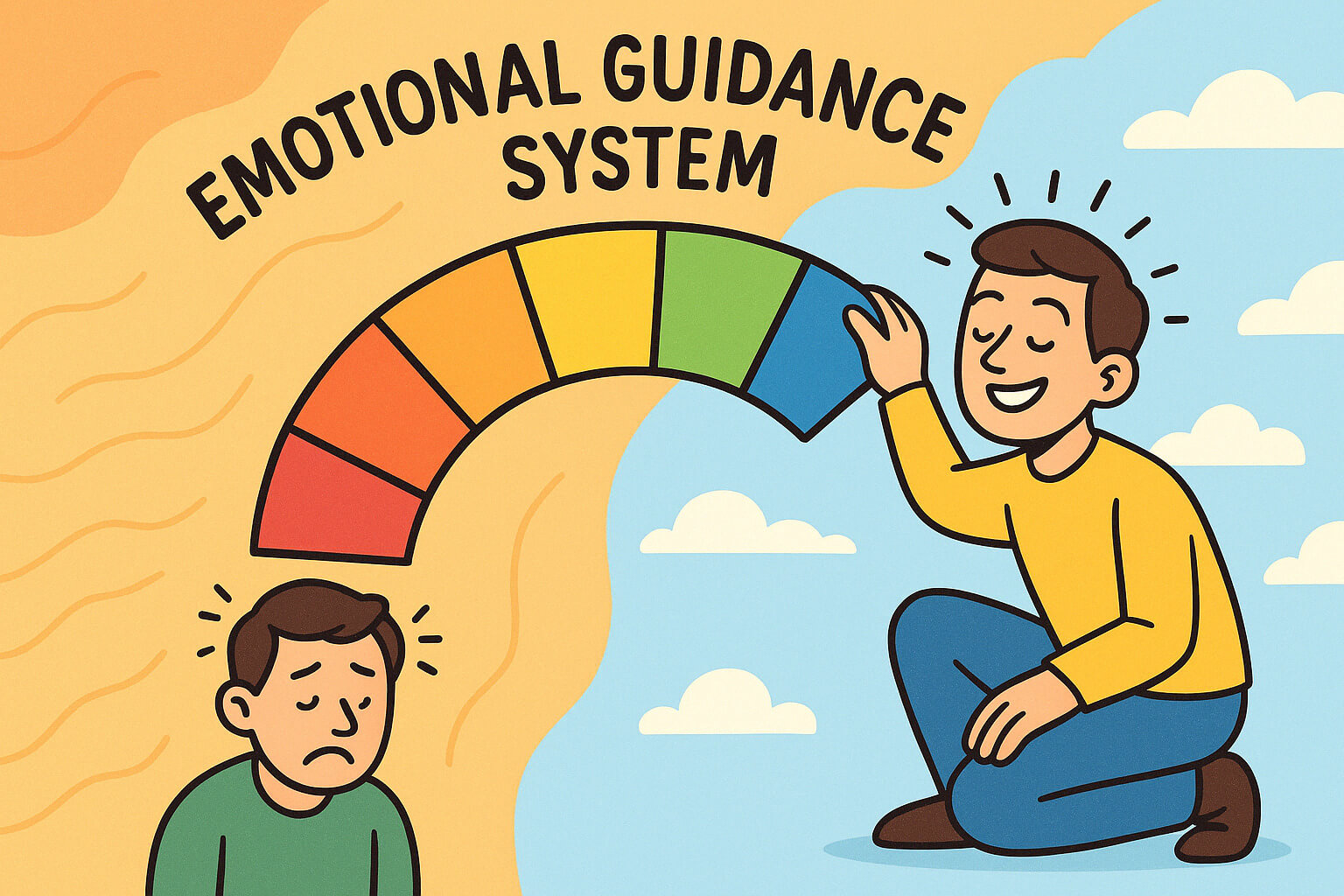
This is the basic idea behind the Emotional Guidance System.
In manifestation teachings, emotions are often viewed as an internal compass. The better you feel, the more you are thought to be moving toward alignment with the experiences, relationships, goals, and life you desire.
The objective isn’t to pretend that negative emotions don’t exist.
The objective is to learn how to work with your emotions instead of being controlled by them.
And you don’t have to jump from fear directly to bliss.
Sometimes the most powerful shift is simply moving from fear to relief, from frustration to hope, or from disappointment to curiosity.
One better-feeling thought can become the beginning of an entirely different emotional direction.
What Is the Emotional Guidance System?
The Emotional Guidance System is a manifestation and personal-development framework built around the idea that your emotions provide feedback about your current thoughts and perspective.
Think of it as an internal GPS.
A GPS doesn’t criticize you when you take a wrong turn. It simply tells you that you are no longer moving in the direction you intended and helps you find another route.
Your emotional experience can be approached in a similar way.
When you feel inspired, hopeful, appreciative, peaceful, enthusiastic, or joyful, you may interpret those emotions as signs that your current thoughts are supporting the direction you want to go.
When you feel persistent fear, resentment, frustration, hopelessness, or discouragement, you can treat those emotions as an invitation to pause and reconsider what you are focusing on.
This doesn’t mean every uncomfortable emotion is “bad.”
Emotions can have many purposes, and difficult feelings are a normal part of life. Sometimes frustration tells you that something needs to change. Disappointment can reveal that you cared deeply about an outcome. Anger can signal that a boundary has been crossed.
The key is not to judge the emotion.
The key is to become conscious of it.
Once you become conscious of your emotional state, you have an opportunity to choose your next thought, action, and direction.

The Emotional Scale: From Lower States to Higher States
Many manifestation teachings describe emotions as existing on a scale, moving from lower-feeling states toward progressively better-feeling states.
The exact order can vary between teachings, and you don’t need to treat the scale as a rigid scientific measurement. Think of it instead as a practical framework for understanding emotional momentum.
A simplified version might look like this:
- Joy, Bliss, Love, Appreciation
- Passion
- Enthusiasm, Eagerness, Happiness
- Positive Expectation, Belief
- Optimism
- Hopefulness
- Contentment
- Boredom
- Pessimism
- Frustration, Irritation, Impatience
- Overwhelm
- Disappointment
- Doubt
- Worry
- Blame
- Discouragement
- Anger
- Revenge
- Hatred, Rage
- Jealousy
- Insecurity, Guilt, Unworthiness
- Fear, Grief, Depression, Powerlessness
The important lesson isn’t the numbers.
It’s the direction.
If you are experiencing a difficult emotion, you don’t have to demand that you suddenly feel joyful.
Instead, ask:
“What would feel slightly better than this?”
That question can change everything.
You Don’t Have to Jump From Fear to Bliss
One of the biggest mistakes people make when working with their emotions is trying to leap too far.
Imagine someone is deeply worried about money.
Telling themselves, “I am incredibly wealthy and everything is perfect!” may not feel believable.
The mind immediately argues back.
“No, I’m not.”
Now there is even more resistance.
A better approach is to move one emotional step at a time.
You might begin with:
“Maybe my financial situation can improve.”
Then:
“There are opportunities I haven’t discovered yet.”
Then:
“I can learn better ways to manage and create money.”
Then:
“I am becoming more capable of creating financial opportunities.”
Notice what is happening.
You aren’t forcing yourself to believe something that feels completely disconnected from your current experience.
You’re looking for a thought that feels more hopeful, more empowering, and more believable.
That is the essence of moving up the emotional scale.
1. Identify Where You Are Emotionally
Before you can change direction, you need to know where you are.
Ask yourself:
What am I feeling right now?
Don’t overcomplicate it.
Are you frustrated?
Worried?
Disappointed?
Bored?
Hopeful?
Excited?
Peaceful?
Joyful?
Simply naming your emotional state creates a moment of awareness between you and your thoughts.
Instead of automatically reacting to everything happening around you, you begin observing your internal experience.
That pause is powerful.
It gives you room to choose your next move.
2. Reach for the Next Better Feeling
Your goal isn’t necessarily to feel amazing immediately.
Your goal is to feel better than you felt a moment ago.
If you’re frustrated, perhaps relief is the next step.
If you’re worried, perhaps hope is the next step.
If you’re disappointed, perhaps acceptance is the next step.
If you’re bored, perhaps curiosity is the next step.
And if you’re already feeling hopeful, perhaps you can reach for optimism.
This is what “working on your feelings” really means.
You are not sitting around waiting for happiness to magically appear.
You are actively looking for thoughts, perspectives, environments, and actions that move you toward a better emotional state.
3. Change the Thought Behind the Feeling
Thoughts and emotions are closely connected.
Change the thought, and your emotional experience can sometimes begin to change with it.
Consider these examples:
Instead of:
“Nothing ever works out for me.”
Try:
“This situation isn’t working yet, but that doesn’t mean it can’t change.”
Instead of:
“I’ll never have enough money.”
Try:
“I can become better at creating, managing, and recognizing opportunities.”
Instead of:
“Everything is going wrong.”
Try:
“What is one thing I can handle right now?”
The new thought doesn’t have to be wildly positive.
It simply needs to give you more room to breathe.
That is often where emotional momentum begins.
4. Practice Appreciation
Appreciation is one of the simplest ways to deliberately shift your attention.
When your mind becomes obsessed with what is missing, appreciation redirects your attention toward what is already present.
You don’t need a perfect life to practice appreciation.
You can appreciate a peaceful morning.
A good conversation.
A beautiful view.
A meal you enjoyed.
A song that lifted your mood.
A lesson you learned.
A person who helped you.
Even a few quiet minutes alone.
The point is not to deny your problems.
It is to remind yourself that your current problem is not the entirety of your experience.
A regular appreciation practice can become a powerful part of a manifestation and mindset routine.
5. Do Something That Makes You Feel Better
Sometimes you cannot think your way into a better emotional state.
You need to change what you are doing.
Take a walk.
Listen to uplifting music.
Spend time in nature.
Clean your environment.
Talk to someone who makes you feel encouraged.
Read something inspiring.
Create something.
Exercise in a healthy, balanced way.
Do something that reconnects you with enthusiasm and possibility.
This matters because your environment, attention, habits, and actions all influence your experience of the present moment.
Don’t underestimate the power of a simple change in activity.
Sometimes the fastest way to interrupt an unhelpful thought pattern is to stop feeding it your attention.
6. Release Resistance and Let Go
Another important part of emotional work is learning not to fight every uncomfortable feeling.
Suppose you’re disappointed.
You might make the situation worse by adding another layer of thought:
“I shouldn’t feel this way.”
Then:
“Why can’t I just be positive?”
Then:
“Something must be wrong with me.”
Now the original disappointment has created frustration and self-judgment.
Instead, try acknowledging the emotion.
“I’m disappointed right now. That’s okay. I don’t have to stay here forever.”
Take a few slow breaths.
Allow yourself to experience the feeling without turning it into a permanent identity.
Then ask:
“What would help me feel a little better?”
That question brings you back into movement.
7. Surround Yourself With Uplifting Influences
Your emotional environment matters.
Pay attention to the conversations you repeatedly have, the information you consume, the people you spend time with, and the subjects that dominate your attention.
If your daily input constantly revolves around fear, outrage, comparison, and negativity, it can become much harder to maintain a hopeful mindset.
This doesn’t mean avoiding every difficult subject or pretending that problems don’t exist.
It means becoming intentional about your mental diet.
Choose books that inspire you.
Follow teachers who encourage personal growth.
Spend time with people who support your goals.
Create an environment that reminds you of the person you are becoming.
Your environment should not control your emotions—but you can make it easier for yourself to access better states of mind.
8. Use Meditation to Take Control of Your Mind
Meditation deserves a special place in any emotional guidance practice.
Why?
Because meditation gives you an opportunity to step back from your thoughts and observe them instead of automatically following every thought that appears.
You sit quietly.
You breathe.
You notice the mind.
A thought appears.
You notice it.
Another thought appears.
You return your attention.
With consistent practice, this can help develop greater awareness of your mental patterns and create a little more space between a thought and your reaction to it.
From a manifestation perspective, that space is extremely valuable.
If your mind is constantly running from one worry to another, it becomes difficult to deliberately choose your focus.
Meditation can become a daily practice for reclaiming that attention.
You don’t need an elaborate ritual.
Start with five or ten quiet minutes.
Sit comfortably.
Close your eyes if that feels comfortable.
Focus on your breathing.
When your attention wanders, gently bring it back.
The objective isn’t to have a completely empty mind.
The objective is to become more conscious of your mind.
And the more conscious you become, the easier it can become to recognize when you’re moving down the emotional scale—and deliberately choose to move back up.

The Power of Emotional Momentum
Here’s where the process becomes particularly interesting.
Emotions can create momentum.
Think about a morning when one frustrating event seemed to lead to another.
You wake up irritated.
You think about something that went wrong yesterday.
Then you become annoyed about today’s responsibilities.
Then somebody says something you don’t like.
Suddenly, you’re carrying an emotional state that began hours earlier.
But momentum can work in the other direction too.
You appreciate something.
You feel slightly better.
You listen to uplifting music.
You feel a little more energized.
You take a walk.
You begin thinking about an exciting goal.
You start feeling hopeful.
Hope leads to optimism.
Optimism leads to enthusiasm.
Enthusiasm leads to action.
And action creates new experiences.
This is why small emotional shifts matter.
You don’t need to change your entire life in one afternoon.
You can change the direction of your attention.
Then change the next thought.
Then choose the next action.
Then repeat.

Higher Emotions and Manifestation
In manifestation traditions, emotions such as love, joy, appreciation, enthusiasm, and positive expectation are often associated with alignment.
The idea is simple:
When you consistently focus your attention on what you appreciate, what you desire, and what is possible, you begin operating from a different internal state than when your attention is dominated by fear, lack, resentment, or hopelessness.
This doesn’t mean that feeling positive guarantees a particular external outcome.
Life is more complicated than that.
But your emotional state can influence how you think, decide, communicate, respond, and act.
A hopeful person may notice possibilities that a discouraged person overlooks.
A confident person may take an opportunity that a fearful person avoids.
A calm person may make a different financial decision than someone acting from panic.
That is where manifestation and practical personal development can meet.
Your emotional state becomes part of the foundation from which you build your life.
Your Goal Is Not to Be Happy All the Time
This is an important distinction.
The purpose of an Emotional Guidance System is not to make you feel happy every second of every day.
That’s unrealistic.
You will experience disappointment.
You will have difficult conversations.
Plans will fail.
People will let you down.
You will sometimes feel angry, worried, frustrated, or discouraged.
That is part of being human.
The goal is to develop enough awareness that you don’t become permanently identified with those states.
You can experience an emotion without allowing it to define your entire day—or your entire future.
You can say:
“This is where I am right now. But this is not where I have to remain.”
Then you begin looking for the next better feeling.
Create Your Own Emotional Guidance Practice
You can turn this entire concept into a simple daily practice.
Each morning, ask yourself:
1. How do I feel right now?
2. What am I currently focusing on?
3. Is that focus helping me or draining me?
4. What thought would feel slightly better?
5. What action could improve my emotional state?
Then take one small step.
At night, ask:
“When did I feel most alive today?”
Pay attention to the moments that brought you enthusiasm, peace, appreciation, connection, or joy.
Those moments provide valuable information about what energizes you.
Over time, you begin to understand yourself better.
You learn what pulls you downward.
You learn what lifts you upward.
And you become increasingly intentional about the direction of your emotional life.
Final Thoughts: Choose the Next Better Feeling
Your emotions don’t have to be something you simply endure.
They can become part of your personal guidance system.
When you’re feeling good, enjoy it.
When you’re feeling inspired, follow the inspiration.
When you’re feeling discouraged, don’t criticize yourself for being there.
Pause.
Breathe.
Become aware.
Then ask the most important question:
“What is the next better feeling I can reach for?”
You don’t have to leap from fear to bliss.
You don’t have to force yourself to feel positive.
You don’t have to pretend everything is perfect.
You simply have to begin moving.
From fear toward relief.
From frustration toward hope.
From hope toward optimism.
From optimism toward enthusiasm.
From enthusiasm toward appreciation.
And eventually, toward those extraordinary states many people spend their lives seeking—joy, love, bliss, freedom, and deep appreciation for being alive.
The real power of the Emotional Guidance System is not in trying to control every emotion.
It is in becoming conscious enough to recognize where you are, decide where you want to go, and take the next step in that direction.
So ask yourself right now:
Where am I on the emotional scale?
And then ask:
What is one thought, one choice, or one action that could help me feel just a little better?
Start there.
One emotional shift at a time, you can begin creating a very different inner experience—and from that new state, make different choices, take different actions, and move toward the life you truly want.