
What if the biggest obstacle between you and the life you want isn’t your circumstances—but the way you see yourself?
You can set goals. You can visualize your dreams, You can repeat affirmations every morning and create the perfect vision board. But if, deep down, you still see yourself as someone who struggles, someone who is unlucky, someone who isn’t capable of earning more, or someone who never gets what they want, your actions may continue to reflect that identity.
This is where self-image and manifestation come together.
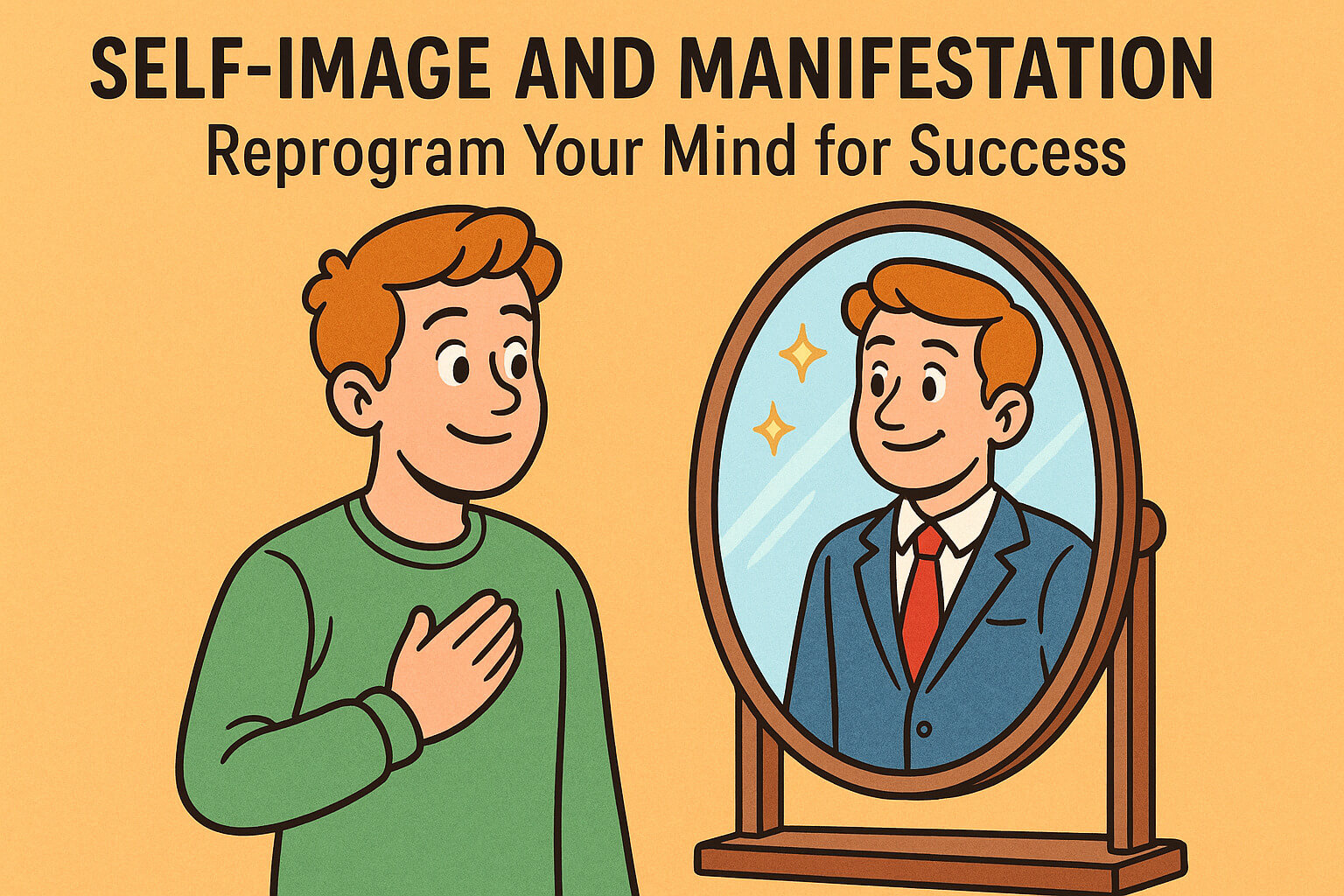
Your self-image is the internal picture you hold of who you are. It influences your expectations, decisions, habits, confidence, and the opportunities you are willing to pursue. From a manifestation perspective, it also represents the identity you are continually reinforcing through your thoughts, emotions, beliefs, and actions.
Change the picture you hold of yourself, and you can begin changing the way you approach your life.
That doesn’t mean simply pretending that circumstances don’t exist. It means developing a new internal identity—and then giving that identity practical expression through your choices.
What Is Self-Image?
Your self-image is the mental picture you have of yourself.
It includes the beliefs you hold about your personality, abilities, worth, potential, relationships, finances, intelligence, confidence, and place in the world.
For example, two people can receive exactly the same opportunity and respond completely differently.
One may think:
“This could change everything. I’m ready for it.”
The other may immediately think:
“I’m probably not qualified. Someone else will get it. I always struggle with things like this.”
The external opportunity is the same.
The internal identity is different.
Over time, repeated thoughts and experiences can strengthen particular beliefs about who you are. If you repeatedly tell yourself that you’re bad with money, for example, you may begin making decisions from that identity. If you repeatedly see yourself as disciplined, capable, and resourceful, you may naturally begin behaving in ways that support those qualities.
This is why self-image matters so much in personal development.
The Connection Between Self-Image and Manifestation
Manifestation teachings often emphasize the idea that your outer experiences begin with your inner world.
The basic principle is simple:
You tend to think, act, choose, and respond according to the person you believe yourself to be.
If your desired future requires you to become more confident, disciplined, financially responsible, creative, courageous, or persistent, then changing your self-image can help you begin practicing those qualities before the external result arrives.
Think about the difference between saying:
“I want to become successful.”
and:
“I am becoming the kind of person who creates success.”
The first statement focuses primarily on the destination.
The second focuses on identity.
This is the deeper connection between self-concept and manifestation. Instead of constantly asking, “How do I get what I want?”, you begin asking:
“Who do I need to become to naturally make choices that move me toward what I want?”
That question can change everything.
Your Current Self-Image May Be Running the Show
Many people don’t consciously choose their self-image.
They inherit it.
Family experiences, criticism, past failures, social conditioning, difficult experiences, comparisons, and repeated statements from other people can all influence the way someone sees themselves.
Eventually, these messages can become internal dialogue.
“I’m not good with money.”
“I’m not confident.”
“I’m always behind.”
“People like me don’t become wealthy.”
“I’m just not lucky.”
“I never finish anything.”
The problem isn’t that one negative thought appears.
Everyone has negative thoughts.
The real issue is when the same message becomes part of your identity.
From a manifestation perspective, this is important because you may be trying to create a new future while continually rehearsing an old identity.
You say you want abundance—but constantly think like someone who expects scarcity.
You want success—but repeatedly tell yourself you’re incapable.
You want confidence—but continually describe yourself as insecure.
The solution isn’t to fight every negative thought.
The solution is to deliberately build a stronger self-image.
How to Improve Your Self-Image for Manifestation Success
Changing your self-image doesn’t require you to become a completely different person overnight.
It begins with small, repeated shifts.
Here are practical ways to start.
1. Identify the Self-Image You Have Now
Before you can change your self-image, you need to become aware of it.
Ask yourself:
- How do I describe myself when nobody is listening?
- What do I believe I’m naturally good at?
- What do I believe I’m incapable of doing?
- How do I see myself financially?
- How do I respond when an exciting opportunity appears?
- What do I expect from my future?
- What do I repeatedly say about myself?
Write your answers down.
Don’t try to make them positive.
Be honest.
You are identifying the programming you currently want to change.
2. Decide Who You Are Becoming
Now create a new identity.
Don’t focus only on possessions.
Instead of writing:
“I have a million dollars.”
ask:
“What kind of person manages, creates, earns, and grows wealth?”
Maybe that person is disciplined.
Maybe they are comfortable learning new skills.
Maybe they take calculated risks.
Maybe they manage their time carefully.
Maybe they don’t give up when something doesn’t work.
Your new self-image should describe the person you are becoming, not simply the things you want to possess.
Write a paragraph beginning with:
“I am becoming a person who…”
Then complete it with qualities that represent the life you want.
3. Practice Visualization
Visualization can be used as a practical form of mental rehearsal.
Close your eyes and imagine yourself operating from your new identity.
Don’t only visualize the final result.
Visualize yourself making the decisions that lead there.
See yourself confidently having the conversation.
See yourself completing the important task.
See yourself managing money responsibly.
See yourself responding calmly when something doesn’t go according to plan.
See yourself continuing when the old version of you would have quit.
This makes visualization much more useful than simply imagining a luxury car or a large bank balance.
You aren’t merely visualizing what you have.
You’re rehearsing who you are becoming.
For more practical visualization exercises, explore our guide to the power of visualization.
4. Use Affirmations That You Can Actually Work With
Affirmations are often used in manifestation practices to reinforce a desired self-concept.
But there is an important distinction.
If an affirmation feels completely disconnected from your current experience, repeating it may simply create frustration.
Instead of forcing yourself to say:
“I am incredibly wealthy.”
you might begin with:
“I am becoming better at creating and managing wealth.”
Or:
“I am learning to think and act from abundance rather than fear.”
Or:
“I trust myself to make better decisions.”
The goal is to create statements that reinforce the identity you are intentionally building.
You can also learn more about how to use affirmations effectively.
5. Change the Way You Talk to Yourself
Pay attention to your everyday language.
There is a tremendous difference between:
“I always mess everything up.”
and:
“That didn’t work. What can I learn from it?”
One statement turns an event into an identity.
The other turns it into information.
You don’t have to pretend that mistakes never happen. Instead, stop using temporary circumstances as permanent definitions of yourself.
Replace:
“I’m terrible with money.”
with:
“I’m learning how to manage money more effectively.”
Replace:
“I’m not confident.”
with:
“I’m becoming more comfortable trusting myself.”
Your words don’t magically create results—but they can influence the story you repeatedly tell yourself.
6. Use the Mirror Technique
The mirror technique is a simple self-image exercise that can be added to your daily routine.
Stand in front of a mirror, look directly into your own eyes, and speak to yourself.
You might say:
“I believe in myself.”
“I trust myself to grow.”
“I am capable of learning new things.”
“I am becoming more confident every day.”
“I am worthy of pursuing the life I want.”
At first, this may feel awkward.
That’s okay.
The purpose isn’t to perform for the mirror. It’s to practice relating to yourself with greater confidence and encouragement.
Try doing it for a few minutes each morning or evening.
With repetition, it can become a powerful reminder of the identity you are choosing to reinforce.
7. Act Like the Person You Are Becoming
This is where manifestation becomes practical.
Ask yourself:
“If I already saw myself as this person, what would I do today?”
If you’re becoming financially responsible, perhaps you review your spending.
If you’re becoming an entrepreneur, perhaps you spend an hour developing your idea.
If you’re becoming confident, perhaps you finally have the conversation you’ve been avoiding.
If you’re becoming disciplined, perhaps you complete the task before entertaining distractions.
You don’t need to wait until you feel like the new person.
Begin giving your desired identity evidence through your actions.
This is the practical side of acting as if.
8. Start Collecting Evidence
Your mind can become very good at noticing evidence that confirms what you already believe.
So deliberately look for evidence of your new identity.
Did you keep a promise to yourself?
That’s evidence.
Did you handle a difficult situation better than you would have previously?
That’s evidence.
Did you save money instead of spending impulsively?
That’s evidence.
Did you take action despite feeling uncertain?
That’s evidence.
Keep a self-image evidence journal.
Every evening, write down three things you did that were consistent with the person you’re becoming.
Small evidence accumulates.
And those small victories can make a new identity feel increasingly believable.
9. Upgrade Your Environment
Your environment constantly gives you cues about how to think and behave.
Look at your surroundings.
Does your environment support the person you’re becoming?
This doesn’t mean you need to buy expensive things or pretend to be wealthy.
It could be as simple as keeping your workspace organized, reducing unnecessary distractions, reading material that supports your goals, or spending more time around people who encourage growth.
Your environment should make it easier—not harder—to practice your desired identity.
10. Stop Waiting for External Proof
One of the biggest traps in manifestation is waiting for the external world to change before allowing yourself to feel different.
“When I have more money, I’ll feel abundant.”
“When I’m successful, I’ll feel confident.”
“When I reach my goal, I’ll finally believe in myself.”
But if your identity is always dependent on external proof, you remain trapped in a cycle of waiting.
Instead, begin practicing the qualities now.
You can practice confidence before the promotion.
You can practice financial responsibility before becoming wealthy.
You can practice gratitude before everything is perfect.
You can practice persistence before you see the result.
The external result may take time.
The internal shift can begin today.

Why Changing Your Self-Image Can Feel Strange
Here is something important to understand.
When you first begin changing your self-image, it may feel completely unnatural.
You may repeat a new affirmation and immediately hear an old thought in your mind.
You may look in the mirror and feel uncomfortable saying something positive about yourself.
You may visualize your desired future and then think, “Who am I kidding?”
You may start acting differently and feel as though you’re pretending.
Don’t automatically interpret that discomfort as failure.
A familiar identity feels comfortable simply because it is familiar.
When you begin thinking, speaking, and behaving differently, you’re stepping outside an established pattern.
That transition can feel strange.
It doesn’t necessarily mean your practice isn’t helping.
At the same time, don’t use discomfort as proof that a manifestation is guaranteed to happen. The more grounded approach is to treat discomfort as a signal to continue practicing while paying attention to real-world results and your behavior.
Give yourself time.
If you have spent years telling yourself that you aren’t capable, you shouldn’t expect one afternoon of affirmations to completely change your internal dialogue.
Persistence matters.
Keep returning to the new identity.
Keep practicing the mirror technique.
Keep visualizing.
Keep changing your self-talk.
Keep taking actions that support the person you want to become.
Eventually, the new way of thinking can begin to feel less unusual.
Self-Image and Wealth: Become the Person Who Can Handle More
The connection between self-image and money deserves special attention.
Many people want more money but have never consciously developed an identity around responsible wealth creation.
Ask yourself:
“If my income increased significantly, would my habits support that increase?”
Would you manage your money differently?
Would you invest in your education?
Would you build new skills?
Would you avoid unnecessary lifestyle inflation?
Would you have the confidence to negotiate?
Would you recognize opportunities?
Manifestation isn’t a substitute for financial knowledge or practical action.
But your self-image can influence whether you are willing to take those actions.
A wealth-oriented identity isn’t simply:
“I am rich.”
It can be:
“I am a person who creates value, learns continuously, manages money intelligently, and looks for opportunities to grow.”
That is an identity you can begin practicing today.
A Simple Daily Self-Image Routine
You don’t need an elaborate routine.
Try this simple practice for the next 30 days.
Morning
1. Mirror — 2 minutes
Look at yourself and repeat three empowering statements.
2. Visualization — 5 minutes
Imagine yourself operating as the person you are becoming.
3. Identity question — 1 minute
Ask:
“What would the person I’m becoming do today?”
Choose one action.
During the Day
Notice negative self-talk.
When you catch yourself making a limiting statement, pause and reframe it.
Then take one small action consistent with your desired identity.
Evening
Write down three pieces of evidence that show you acted like the person you’re becoming.
That’s it.
Simple.
But consistency is more valuable than creating an elaborate routine you abandon after three days.
The Real Shift: From Chasing to Becoming
There is a powerful difference between chasing a new life and becoming the person capable of creating one.
You don’t have to wait for success before practicing confidence.
You don’t have to wait for wealth before practicing financial responsibility.
You don’t have to wait for recognition before believing that your work has value.
You don’t have to wait for the perfect circumstances before developing discipline.
Begin with the identity.
Then reinforce it with your thoughts.
Reinforce it with your words.
Reinforce it with your habits.
And, most importantly, reinforce it with your actions.
This is where the spiritual idea of manifestation meets practical personal development.
You set the intention.
You cultivate the identity.
You align your thoughts and behavior with that identity.
Then you take action in the physical world.
The results may not appear overnight. But every time you choose differently, you are giving yourself a new piece of evidence about who you are.
And that may be the most important manifestation practice of all.
Change the picture you hold of yourself. Change the way you think and act. And give your new identity enough time and consistency to become the person you naturally live from.